
SMC 2011 Q22
22. In the diagram, \(\angle ABE = 10°\); \(\angle EBC = 70°\); \(\angle ACD = 50°\); \(\angle DCB = 20°\); \(\angle DEF = \alpha\).
Which of the following is equal to \(\tan\alpha\)?
- A \(\dfrac{\tan 10° \tan 20°}{\tan 50°}\)
- B \(\dfrac{\tan 10° \tan 20°}{\tan 70°}\)
- C \(\dfrac{\tan 10° \tan 50°}{\tan 70°}\)
- D \(\dfrac{\tan 20° \tan 50°}{\tan 70°}\)
- E \(\dfrac{\tan 10° \tan 70°}{\tan 50°}\)
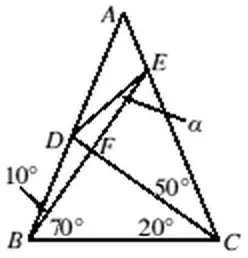
Senior Mathematical Challenge 2011, Question 22. © UK Mathematics Trust. Original paper on ukmt.org.uk
Answer: A \(\dfrac{\tan 10° \tan 20°}{\tan 50°}\)
As the sum of the angles in a triangle is 180°, in triangle \(CBF\), \(\angle BFC = 90°\). As vertically opposite angles are equal \(\angle DFE = \angle BFC = 90°\). As the sum of the angles on a straight line is 180°, \(\angle DFB = \angle EFC = 90°\). Hence in triangle \(EFD\), \(\tan\alpha = \tfrac{DF}{EF}\): in triangle \(DFB\), \(\tan 10° = \tfrac{DF}{FB}\): in triangle \(BFC\), \(\tan 20° = \tfrac{FB}{FC}\) and in triangle \(CEF\), \(\tan 50° = \tfrac{EF}{FC}\). Thus \(\tan\alpha = \tfrac{DF}{EF} = \tfrac{\tan 10° FB}{EF} = \tfrac{\tan 10°\ \tan 20° FC}{EF} = \tfrac{\tan 10°\ \tan 20°}{\tan 50°}\).
Solution © UK Mathematics Trust, from the SMC 2011 solutions. Longer versions with investigations: Solutions and investigations (PDF).