
SMC 2010 Q19
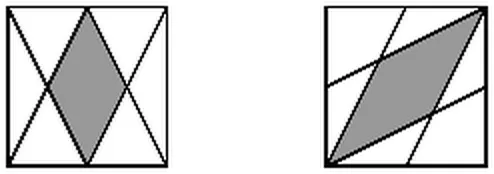
19. The diagrams show two different shaded rhombuses, each inside a square with sides of length 6.
Each rhombus is formed by joining vertices of the square to midpoints of the sides of the square. What is the difference between the shaded areas?
- A 4
- B 3
- C 2
- D 1
- E 0
Senior Mathematical Challenge 2010, Question 19. © UK Mathematics Trust. Original paper on ukmt.org.uk
Answer: B 3
In the rhombus on the left, drawing vertical straight lines at distances of \(1\tfrac{1}{2}\), 3 and \(4\tfrac{1}{2}\) from the left edge of the square, and a horizontal straight line bisecting the square, creates 16 equivalent triangles. Of these, four are shaded giving a total shaded area of \(\tfrac{1}{4} \times 6 \times 6 = 9\).
Draw in the diagonal from NW to SE in the rhombus on the right. The four unshaded triangles now above the shaded area are all equal in area (\(a\) say); and one can see that 3 of these together make up \(\tfrac{1}{4}\) of the square. Hence \(a = 3\). Thus the shaded area equals \(36 - 3 \times 8 = 12\).
Therefore the difference between the shaded areas is \(12 - 9 = 3\).
Solution © UK Mathematics Trust, from the SMC 2010 solutions. Longer versions with investigations: Solutions and investigations (PDF).