
IMC 2011 Q25
25. The diagram shows a square, a diagonal and a line joining a vertex to the midpoint of a side. What is the ratio of area \(P\) to area \(Q\)?
- A \(1 : \sqrt{2}\)
- B 2 : 3
- C 1 : 2
- D 2 : 5
- E 1 : 3
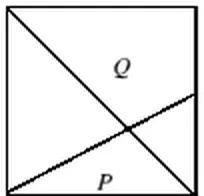
Intermediate Mathematical Challenge 2011, Question 25. © UK Mathematics Trust. Original paper on ukmt.org.uk
Answer: D 2 : 5
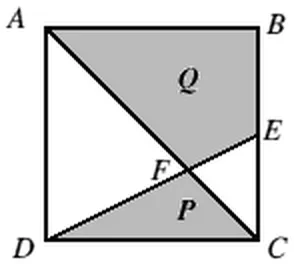
Let triangle \(CEF\) have area \(a\). Note that \(\angle AFD = \angle CFE\) (vertically opposite angles) and \(\angle DAF = \angle ECF\) (alternate angles), so triangles \(ADF\) and \(CEF\) are similar.
Note also that the side \(AD\) is twice the length of the corresponding side \(CE\).
Hence:
(i) triangle \(ADF\) has area 4\(a\) and;
(ii) \(AF\) has twice the length of the corresponding side \(CF\).
View \(AF\) and \(CF\) as bases of the triangles \(ADF\) and \(CDF\) (which then share the same height). Therefore, by (ii), triangle \(ADF\) has twice the area of triangle \(CDF\) (area P), which thus is 2\(a\).
The area of triangle \(ACD\) is 6\(a\); so that of triangle \(ABC\) is also 6\(a\) and that of area Q is 5\(a\). So the required ratio is 2 : 5.
Solution © UK Mathematics Trust, from the IMC 2011 solutions. Longer versions with investigations: Solutions and investigations (PDF).