
IMC 2005 Q25
25. This regular hexagon has been divided into four trapezia and one hexagon. If each of the five sections has the same perimeter, what is the ratio of the lengths \(p\), \(q\) and \(r\) ?
- A 8 : 2 : 1
- B 12 : 4 : 1
- C 9 : 3 : 1
- D 6 : 3 : 1
- E 9 : 4 : 1
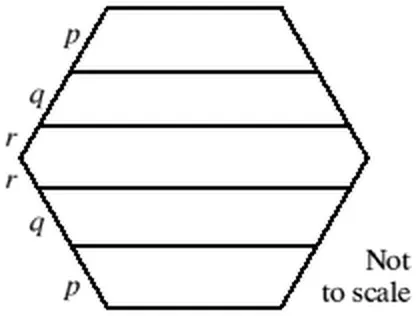
Intermediate Mathematical Challenge 2005, Question 25. © UK Mathematics Trust. Original paper on ukmt.org.uk
Answer: B 12 : 4 : 1
Each exterior angle of a regular hexagon = 360° ÷ 6 = 60°, so when sides \(HB\) and \(IC\) are produced to meet at \(A\), an equilateral triangle, \(ABC\), is created. Let the sides of this triangle be of length \(x\). As \(BC\), \(DE\) and \(FG\) are all parallel, triangles \(ABC\), \(ADE\) and \(AFG\) are all equilateral. So \(DE = DA = p + x\); \(FG = FA = q + p + x\).
The perimeter of trapezium \(BCED = x + p + x + 2p\) \(= 2x + 3p\); the perimeter of trapezium \(DEGF =\) \((p + x) + (q + p + x) + 2q\) \(= 2x + 2p + 3q\); the perimeter of hexagon \(FGIKJH = 2((q + p + x) + 2r)\) \(= 2x + 2p + 2q + 4r\).
So \(2x + 3p = 2x + 2p + 3q\); hence \(p = 3q\). Also \(2x + 2p + 3q\) \(= 2x + 2p + 2q + 4r\); hence \(q = 4r\). So \(p : q : r\) \(= 12r : 4r : r\) \(= 12 : 4 : 1\).
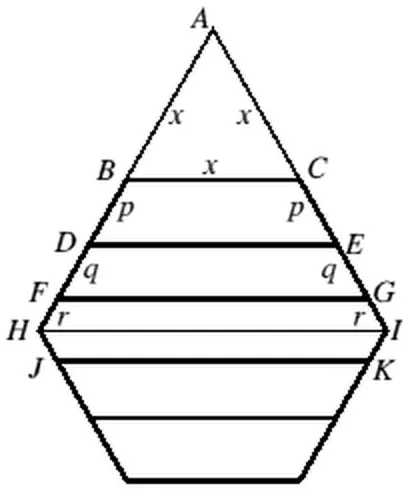
Solution © UK Mathematics Trust, from the IMC 2005 solutions.