
IMC 2005 Q19
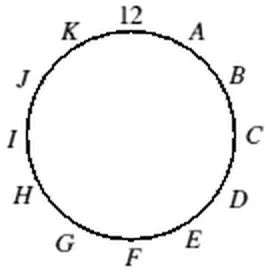
19. Trinni is fascinated by triangle numbers (1, 3, 6, 10, 15, 21, etc.) and recently, coming across a clock, she found that she could rearrange the twelve numbers 1, 2, 3, … 12 around the face so that each adjacent pair added up to a triangle number. She left the 12 in its usual place; what number did she put where the 6 would usually be?
- A 1
- B 4
- C 5
- D 10
- E 11
Intermediate Mathematical Challenge 2005, Question 19. © UK Mathematics Trust. Original paper on ukmt.org.uk
Answer: C 5
For ease of reference, label the points \(A, B, C, \ldots, K\) as shown. First note that \(A = 3\) and \(K = 9\) or vice versa. With no loss of generality, let \(A = 3\). Then the only possible values for \(B\), \(C\) and \(D\) are 7, 8 and 2 respectively. This gives \(E = 1\) or 4 and, as \(K = 9\), \(J = 1\) or 6. If \(J = 1\), then \(E = 4\) and the only remaining possibilities for \(I\), \(H\) and \(G\) are 5, 10 and 11 respectively. This means that \(F = 6\), but 11 + 6 is not a triangle number, so \(J\) is not 1 and must, therefore, be 6. This means that \(I = 4\) and hence \(E = 1\). The remaining values may now be assigned: \(H = 11\), \(G = 10\) and \(F = 5\).
Solution © UK Mathematics Trust, from the IMC 2005 solutions.