
IMC 2004 Q23
23. In the diagram, the letter \(S\) is made from two arcs, \(KL\) and \(MN\), which are each five-eighths of the circumference of a circle of radius 1, and the line segment \(LM\), which is tangent to both circles. At points \(K\) and \(N\), common tangents to the two circles touch one of the circles. What is the length \(LM\)?
- A \(\dfrac{3}{2}\)
- B \(3 - \sqrt{2}\)
- C 2
- D \(\dfrac{3\sqrt{2}}{2}\)
- E \(1 + \sqrt{2}\)
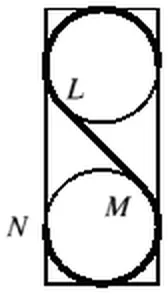
Intermediate Mathematical Challenge 2004, Question 23. © UK Mathematics Trust. Original paper on ukmt.org.uk
Answer: C 2
Let the centres of the circles be \(J\) and \(O\) and let \(NI\) be the common tangent shown. Let \(P\) be the point of intersection of \(JO\) and \(LM\). As arc \(KL\) is 5/8 of the circumference of the top circle, \(\angle IJL\) = 45°. Consider quadrilateral \(IJON\): sides \(IJ\) and \(NO\) are radii, so they are both of unit length and they are both perpendicular to tangent \(NI\). So \(IJON\) is a rectangle. Hence \(\angle IJO\) = 90° and \(\angle LJP\) = 90° − 45° = 45°. In triangle \(JLP\), \(\angle JPL\) = 180° − (90° + 45°) = 45°. So triangle \(JLP\) is isosceles and \(LP = LJ = 1\) unit.
By a similar argument, it may be shown that \(PM\) is also of length 1 unit, so \(LM = LP + PM = 2\) units.
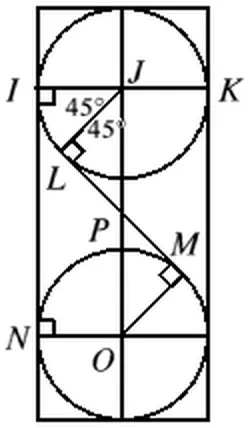
Solution © UK Mathematics Trust, from the IMC 2004 solutions.