
SMC 2008 Q8
8. In the figure shown, \(AB = AF\) and \(ABC\), \(AFD\), \(BFE\) and \(CDE\) are all straight lines.
Which of the following expressions gives \(z\) in terms of \(x\) and \(y\)?
- A \(\dfrac{y - x}{2}\)
- B \(y - \dfrac{x}{2}\)
- C \(\dfrac{y - x}{3}\)
- D \(y - \dfrac{x}{3}\)
- E \(y - x\)
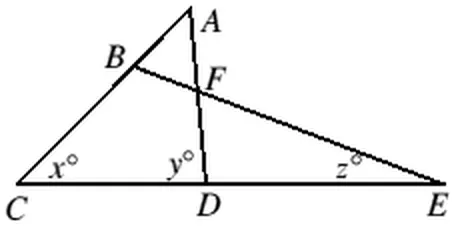
Senior Mathematical Challenge 2008, Question 8. © UK Mathematics Trust. Original paper on ukmt.org.uk
Answer: A \(\dfrac{y - x}{2}\)
In triangle \(ACD\), \(\angle CAD = (180 - x - y)°\).
As \(AB = AF\), triangle \(ABF\) is isosceles hence \(\angle ABF = \angle AFB = \tfrac{1}{2}(x + y)°\).
Thus \(\angle DFE = \angle AFB = \tfrac{1}{2}(x + y)°\) (vertically opposite angles). Now in triangle \(DFE\), \(\angle FDE = (180 - y)°\). Hence \(z° = 180° - \angle DFE - \angle FDE = \tfrac{1}{2}(y - x)°\).
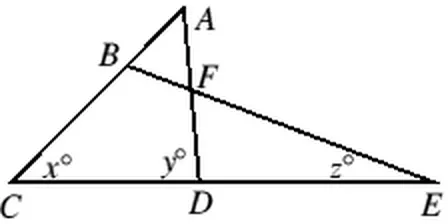
Solution © UK Mathematics Trust, from the SMC 2008 solutions.