
SMC 2018 Q24
24. The diagram shows a circle with centre \(O\) which lies in a horizontal plane. The diameter \(AB\) has length 4. Point \(P\) lies vertically above \(O\) and \(PO = 2\sqrt{2}\). Point \(C\) lies on the semicircular arc \(AB\) such that the ratio of the lengths of the arcs \(AC\) and \(CB\) is 2 : 1.
What is the shortest distance from \(A\) to \(PC\)?
- A \(\sqrt{2}\)
- B \(\sqrt{3}\)
- C 2
- D \(2\sqrt{2}\)
- E 3
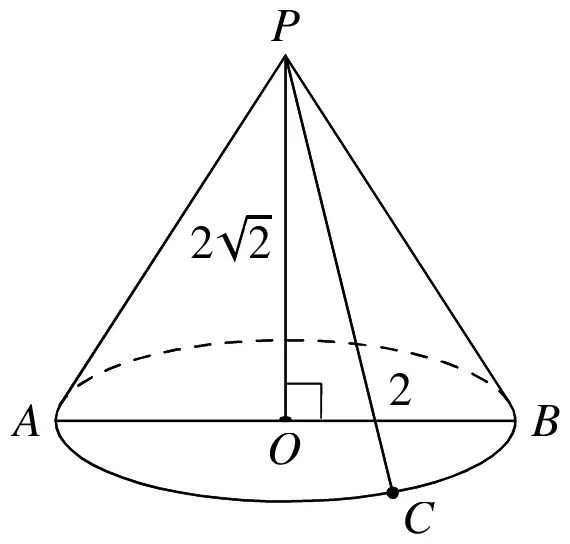
Senior Mathematical Challenge 2018, Question 24. © UK Mathematics Trust. Original paper on ukmt.org.uk
Answer: E 3
As points \(A\) and \(C\) are both on the circular base with centre \(O\), and \(P\) is directly above \(O\), we have \(PA = PC\). Applying Pythagoras’ Theorem to triangle \(OPA\) gives \(PA^2 = 2^2 + (2\sqrt{2})^2 = 12\), so \(PA = 2\sqrt{3} = PC\). Now we consider the circular base. Since the arcs \(AC\) and \(CB\) are in the ratio 2 : 1, then \(\angle AOC : \angle COB\) is also 2 : 1, giving \(\angle COB = 60°\). Triangle \(BOC\) is therefore equilateral, as \(OB = OC\), giving us that \(BC = 2\). Triangle \(ACB\) is right-angled, as angles in a semicircle are 90°. Applying Pythagoras’ Theorem to triangle \(ACB\) gives \(AC^2 + 2^2 = 4^2\), so \(AC = 2\sqrt{3}\).
As \(PA = PC = AC = 2\sqrt{3}\), triangle \(PAC\) is now shown to be equilateral. The shortest distance \(h\) from \(A\) to line \(PC\) is therefore the line of symmetry of that equilateral triangle. So \(h^2 + \sqrt{3}^2 = (2\sqrt{3})^2\) giving \(h^2 = 9\) and therefore \(h = 3\).
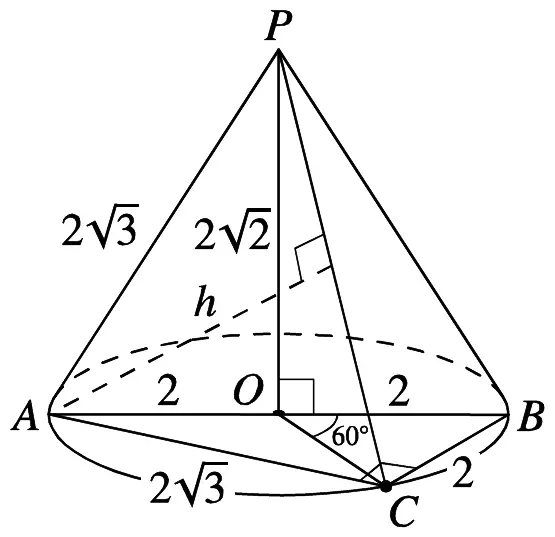
Solution © UK Mathematics Trust, from the SMC 2018 solutions. Longer versions with investigations: Solutions and investigations (PDF).