
SMC 2017 Q22
22. The diagram shows a regular octagon and a square formed by drawing four diagonals of the octagon. The edges of the square have length 1.
What is the area of the octagon?
- A \(\dfrac{\sqrt{6}}{2}\)
- B \(\dfrac{4}{3}\)
- C \(\dfrac{7}{5}\)
- D \(\sqrt{2}\)
- E \(\dfrac{3}{2}\)
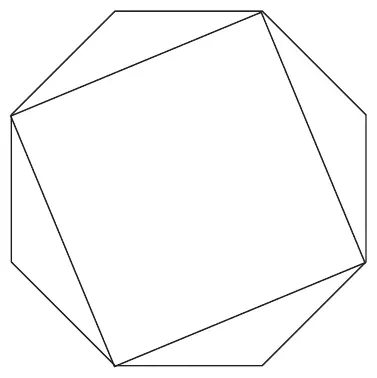
Senior Mathematical Challenge 2017, Question 22. © UK Mathematics Trust. Original paper on ukmt.org.uk
Answer: D \(\sqrt{2}\)
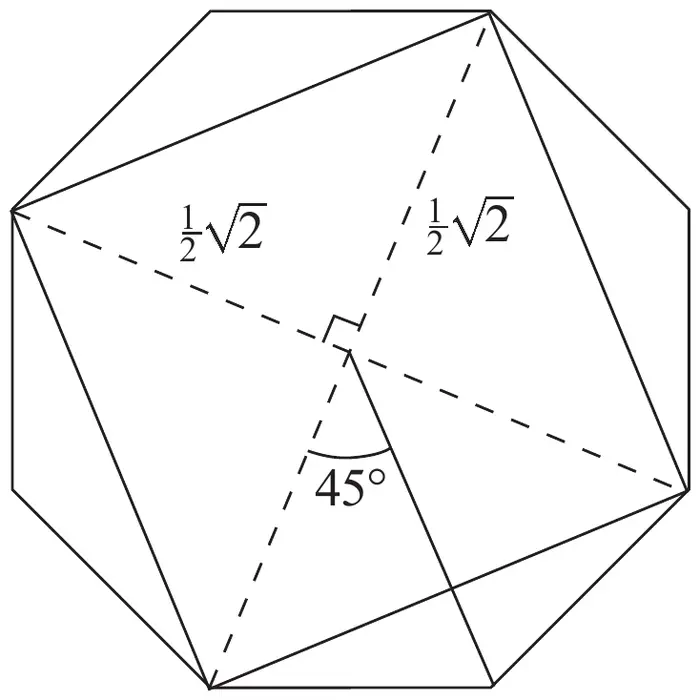
The square can be split into four congruent right-angled triangles by joining each of its vertices to the centre. Each edge of the square has length 1, so the shorter sides of each triangle have length \(\tfrac{1}{2}\sqrt{2}\).
The regular octagon can be split into eight congruent isosceles triangles whose longer sides have length \(\tfrac{1}{2}\sqrt{2}\), by joining all eight vertices to the centre. These sides are separated by an angle of \(\tfrac{1}{8} \times 360° = 45°\). Using the formula ‘area \(= \tfrac{1}{2}ab\sin C\)’, the total area of the octagon is \(8 \times \tfrac{1}{2} \times \tfrac{1}{2}\sqrt{2} \times \tfrac{1}{2}\sqrt{2}\sin 45° = 2\sin 45° = 2 \times \frac{1}{\sqrt{2}} = \sqrt{2}\).
Solution © UK Mathematics Trust, from the SMC 2017 solutions. Longer versions with investigations: Solutions and investigations (PDF).