
IMC 2019 Q23
23. The diagram shows a triangle with sides \(n^2 + n\), \(2n + 12\) and \(3n + 3\).
What is the sum of all the values of \(n\) for which the triangle is isosceles?
- A 7
- B 9
- C 12
- D 13
- E 16
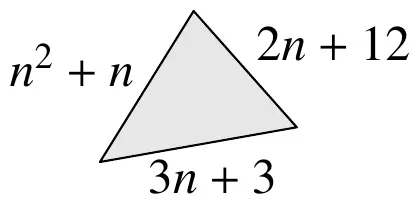
Intermediate Mathematical Challenge 2019, Question 23. © UK Mathematics Trust. Original paper on ukmt.org.uk
Answer: A 7
The triangle is isosceles when one of the following three equations is true:
When equation (1) is true, we have \(n^2 - n - 12 = 0\), so that \((n - 4)(n + 3) = 0\).
Hence either \(n = 4\) or \(n = -3\). However, when \(n = -3\) then \(3n + 3 < 0\), so that no triangle can be formed. There is, though, an isosceles triangle when \(n = 4\), as the sides of the triangle are then 20, 20 and 15.
When equation (2) is true,we have \(n^2 - 2n - 3 = 0\), so that \((n - 3)(n + 1) = 0\).
Hence either \(n = 3\) or \(n = -1\). However, when \(n = -1\) then \(3n + 3 = 0\), so that no triangle can be formed. There is, though, an isosceles triangle when \(n = 3\), as the sides of the triangle are then 12, 18 and 12.
When equation (3) is true, we have \(n = 9\).
But then \(n^2 + n = 90\) and \(3n + 3 = 30 = 2n + 12\), so that no triangle can be formed at all in this case, because 90 > 30 + 30.
Hence the required sum is 3 + 4 = 7.
Solution © UK Mathematics Trust, from the IMC 2019 solutions. Longer versions with investigations: Solutions and investigations (PDF).