
JMC 2016 Q20
20. A cyclic quadrilateral has all four vertices on the circumference of a circle. Brahmagupta (598–670AD) gave the following formula for the area, \(A\), of a cyclic quadrilateral whose edges have lengths \(a\), \(b\), \(c\), \(d\):
\(A = \sqrt{(s - a)(s - b)(s - c)(s - d)}\), where \(s\) is half of the perimeter of the quadrilateral.
What is the area of the cyclic quadrilateral with sides of length 4 cm, 5 cm, 7 cm and 10 cm?
- A 6 cm2
- B 13 cm2
- C 26 cm2
- D 30 cm2
- E 36 cm2
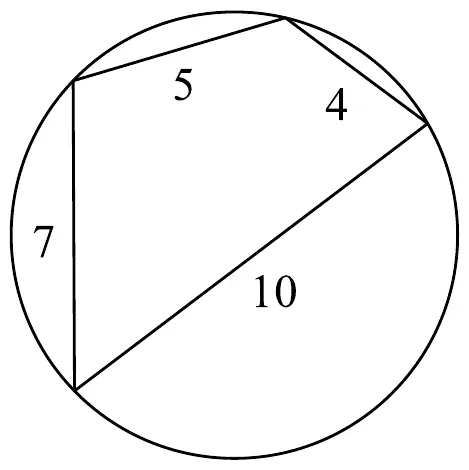
Junior Mathematical Challenge 2016, Question 20. © UK Mathematics Trust. Original paper on ukmt.org.uk
Answer: E 36 cm2
The length of \(s\), half the perimeter of the cyclic quadrilateral, is \(\tfrac{1}{2}(4 + 5 + 7 + 10)\) cm = 13 cm. So the required area, in cm2, is \(\sqrt{(13 - 4)(13 - 5)(13 - 7)(13 - 10)} = \sqrt{9 \times 8 \times 6 \times 3} = \sqrt{9 \times 144} = 3 \times 12 = 36\).
Solution © UK Mathematics Trust, from the JMC 2016 solutions. Longer versions with investigations: Solutions and investigations (PDF).