
SMC 2015 Q19
19. Three squares are arranged as shown so that their bases lie on a straight line. Also, the corners \(P\), \(Q\) and \(R\) lie on a straight line. The middle square has sides that are 8 cm longer than the sides of the smallest square. The largest square has sides of length 50 cm.
There are two possible values for the length (in cm) of the sides of the smallest square. Which of the following are they?
- A 2, 32
- B 4, 42
- C 4, 34
- D 32, 40
- E 34, 42
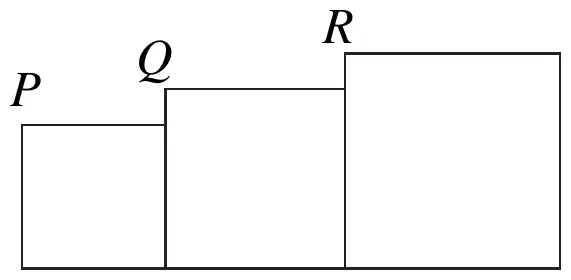
Senior Mathematical Challenge 2015, Question 19. © UK Mathematics Trust. Original paper on ukmt.org.uk
Answer: A 2, 32
Let the length of the side of the smallest square be \(x\) cm. So the three squares have sides of lengths \(x\) cm, \((x + 8)\) cm and 50 cm respectively. The gradient of \(PQ\) is then \(\tfrac{8}{x}\) and the gradient of \(PR\) is \(\dfrac{50 - x}{x + x + 8}\). As \(P\), \(Q\) and \(R\) lie on a straight line, \(\dfrac{8}{x} = \dfrac{50 - x}{2x + 8}\) so \(8(2x + 8) = x(50 - x)\). Expanding gives \(16x + 64 = 50x - x^2\) and therefore \(x^2 - 34x + 64 = 0\), giving \(x = 2\) or 32.
Solution © UK Mathematics Trust, from the SMC 2015 solutions. Longer versions with investigations: Solutions and investigations (PDF).