
SMC 2015 Q17
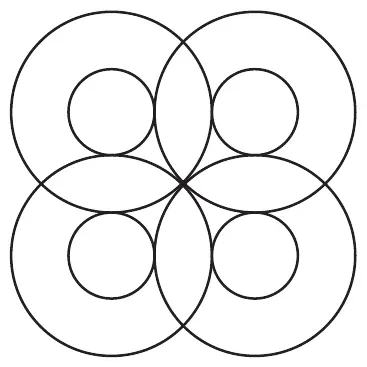
17. The diagram shows eight circles of two different sizes. The circles are arranged in concentric pairs so that the centres form a square. Each larger circle touches one other larger circle and two smaller circles. The larger circles have radius 1. What is the radius of each smaller circle?
- A \(\tfrac{1}{3}\)
- B \(\tfrac{2}{5}\)
- C \(\sqrt{2} - 1\)
- D \(\tfrac{1}{2}\)
- E \(\tfrac{1}{2}\sqrt{2}\)
Senior Mathematical Challenge 2015, Question 17. © UK Mathematics Trust. Original paper on ukmt.org.uk
Answer: C \(\sqrt{2} - 1\)
Let the radius of each of the smaller circles be \(r\) and let the centres of the circles be \(A\), \(B\), \(C\) and \(D\) in order. We are given that \(ABCD\) is a square. When two circles touch externally, the distance between their centres equals the sum of their radii. Hence \(AB\) and \(BC\) have length \(r + 1\) and \(AC\) has length \(1 + 1 = 2\). By Pythagoras' Theorem \((r + 1)^2 + (r + 1)^2 = 2^2\), so \(2(r + 1)^2 = 2^2 = 4\) and therefore \((r + 1)^2 = 2\). Square rooting both sides gives \(r + 1 = \sqrt{2}\), as we must take the positive root, and so \(r = \sqrt{2} - 1\).
Solution © UK Mathematics Trust, from the SMC 2015 solutions. Longer versions with investigations: Solutions and investigations (PDF).