
JMC 2019 Q25
25. The diagram shows the first fifteen positive integers arranged in a ‘triangle’.
These numbers are to be rearranged so that the five integers along each ‘edge’ of the triangle have the same sum, unlike the example shown.
When this is done, what is the greatest possible such sum?
- A 38
- B 42
- C 48
- D 52
- E 54
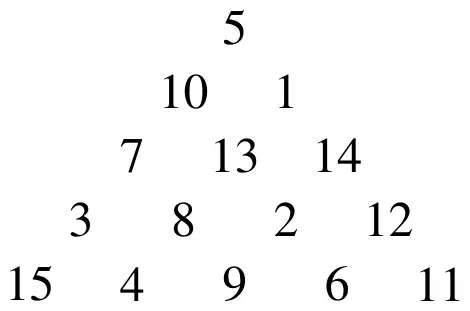
Junior Mathematical Challenge 2019, Question 25. © UK Mathematics Trust. Original paper on ukmt.org.uk
Answer: D 52
Note that there are three integers in the centre of the ‘triangle’. For the sum of the integers on each edge to be equal and a maximum, it is preferable for these integers to be 1, 2 and 3. When this is the case, the sum of the remaining integers is \(4 + 5 + 6 + \cdots + 13 + 14 + 15 = 114\). Note that the three integers at the vertices of the triangle contribute to the totals of the integers on two edges of the triangles. So for these three totals to be a maximum, it would be preferable for these integers at the vertices to be 13, 14 and 15. When this is the case, the sum of the integers on the three edges of the triangle is 114 + 13 + 14 + 15 = 156. So, the greatest possible total of the five integers on each edge of the triangle when these totals are equal, is at most \(\dfrac{156}{3} = 52\).
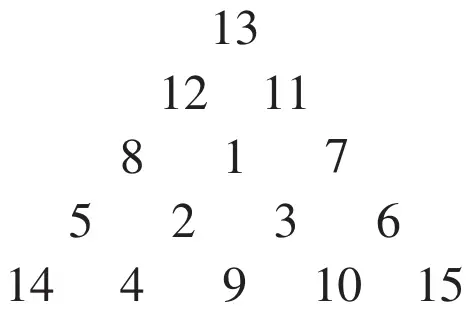
The diagram shows that it is possible for the three totals to all equal 52.
Solution © UK Mathematics Trust, from the JMC 2019 solutions. Longer versions with investigations: Solutions and investigations (PDF).