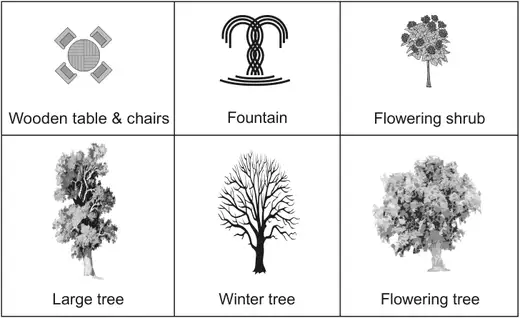
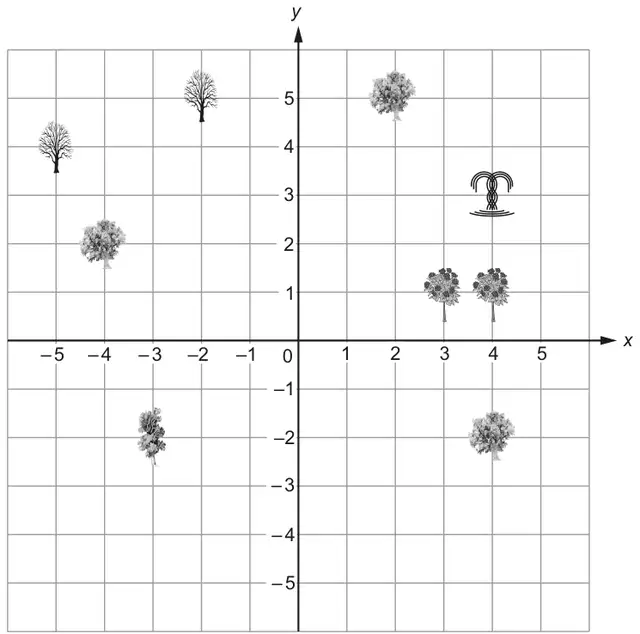
1. A landscape gardener designs gardens. He uses a coordinate grid to show the position of plants and trees. He has started to create a plan for one of his customers. The table below shows some of the items that are to be put into the garden.
(a) What are the coordinates of the fountain? Circle your answer. [1]
(4, 3) (3, 3) (3, –3) (3, 4) (4, –3)
(b) The gardener is going to place
the wooden table and chairs at A (–1, 2)
a flowering shrub at B (1, 0).
Plot the positions of points A and B on the grid above. [2]
(c) The lawn in the garden is rectangular. It has length 4·5 metres and width 3 metres.
(i) What units should be used for the area of the lawn? Circle your answer. [1]
m cm m2 m3 yards
(ii) What is the area of the lawn? [2]
(d)
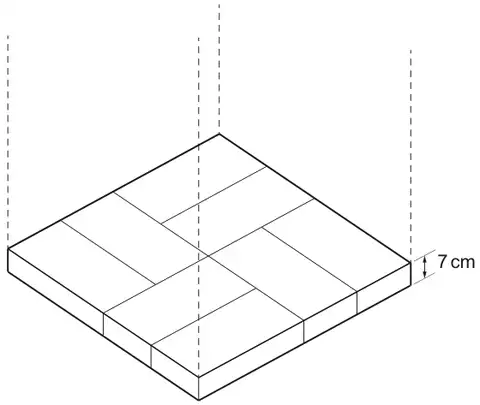
The gardener has a stack of bricks to build a barbeque. The stack is 154 cm tall.
Each layer of bricks has the pattern shown below.
The thickness of one layer of bricks is 7 cm. How many bricks are there in the stack altogether? [4]
Mark scheme (a)
Scheme
Marks
Comments
(4, 3)
B1
Mark scheme (b)
Scheme
Marks
Comments
Points plotted at (-1, 2) and (1, 0)
B2
Accept any unambiguous indication of the points. Award B1 for either plotted correctly.
Award SC1 if only the correct points are plotted but are incorrectly labelled.
Mark scheme (c)
Scheme
Marks
Comments
(i) m2
B1
(ii) 4.5 × 3 13.5 (m2)
M1 A1
If (i) not attempted but answer in (ii) has m2 then award B1 for (i).
Mark scheme (d)
Scheme
Marks
Comments
(Number of layers =) 154 ÷ 7
22
(Number of bricks =) 22 × 8
176
M1 A1
M1
A1
Award M1 A1 for 7 ÷ 154 = 22. Award M0A0 for 7 ÷ 154 = 21 (i.e. for a slip in working) FT ‘their 22’ Do not FT for 154 × 8 or 7 × 8
We'd like to use Google Analytics cookies to count visits and see which pages help most. They're optional, and the site works exactly the same either way. Privacy policy