
Numeracy Higher June 2018 Unit 2 Q10
10.
A shelf support is made by attaching a cylinder to a right-angled triangular prism.
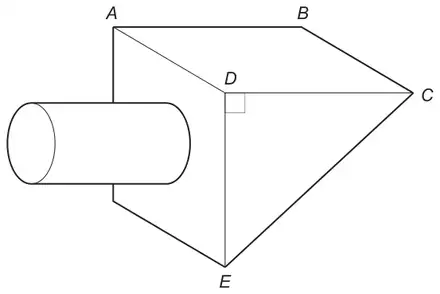
Diagram not drawn to scale
The cylinder has a diameter of 6 mm and a length of 9 mm.
The prism has dimensions CD = 8 mm, DE = 8 mm, CE = 11·3 mm and BC = 10 mm.
The company sells the shelf supports in packs of 500.
It needs to know the volume of plastic in 500 shelf supports.
Calculate the volume of 500 shelf supports. [4]
Volume of 500 shelf supports = ……………………
One of the door handles it makes is shown below.
It is formed by joining two cylinders.
One of the cylinders has a diameter of 4 cm and a length of 1·2 cm.
The other cylinder has a diameter of 1·8 cm and a length of 3 cm.
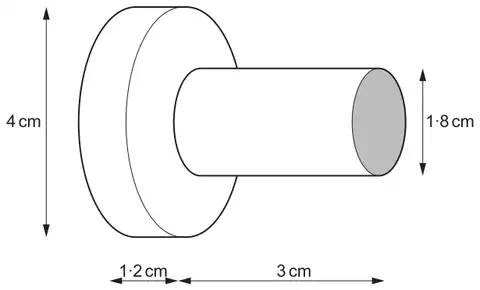
Diagram not drawn to scale
At present, the company paints all the surfaces of the handle with a protective finish after the two cylinders have been joined together.
The shaded circular face is pressed against a cupboard door when fitted.
In future, the company is not going to paint this shaded circular face. This is to reduce costs.
Calculate the percentage reduction in the area that is painted. [6]
From the formula list: Volume of prism = area of cross-section × length
| Scheme | Marks | Comments |
|---|---|---|
| (Volume of 500 supports =) π × 32 × 9 + (8 × 8)/2 × 10 (81π or 254·…) (320) | M2 | M1 for summing 2 terms, with 1 correct |
| × 500 = 287 170 to 287 251 (mm3) | m1 A1 | FT from M1 for m1 only Or 500(320 + 81π) (mm3) or 160000 + 40500π (mm3) ISW |
| Scheme | Marks | Comments |
|---|---|---|
| Sight of area of 1 of the curved surfaces π × 4 × 1·2 OR π × 1·8 × 3 | B1 | |
| (π × 22) × 2 + π×4×1·2 + π×1·8×3 (25·1…) (15·07..) (16·9…) (8π) (4·8π) (5·4π) | M2 | Or equivalent M1 for a calculation involving 3 or more terms with at least the equivalent of 2 of these terms correct |
| = 57·07 to 57·24 (cm2) | A1 | Or 18·2π or equivalent. CAO |
| (% reduction =) \(\dfrac{\pi \times 0{\cdot}9^{2}}{57(\cdot\ldots)}\) (×100) OR \(\dfrac{2{\cdot}5(\ldots)}{57(\cdot\ldots)}\) (×100) OR \(\dfrac{0{\cdot}81\pi}{18{\cdot}2\pi}\) (×100) | M1 | FT ‘their derived 57·07 to 57·24’ (π × 0·92 = 2·5(434) to 2·55) |
| = 4·3(67…) to 4·5 (%) | A1 | Accept an answer of 4(%) from correct working Alternative method for % reduction: M1 for 1(×100) – \(\dfrac{(57(\cdot\ldots) - 2{\cdot}5(\ldots))}{57(\cdot\ldots)}\)(×100) FT ‘their derived 57·07 to 57·24’ A1 for 4·3(67…) to 4·5 (%) Accept an answer of 4(%) from correct working |