
Numeracy Higher November 2017 Unit 1 Q9
9. Two runners, Catrin and Delyth, start a race at the same time.
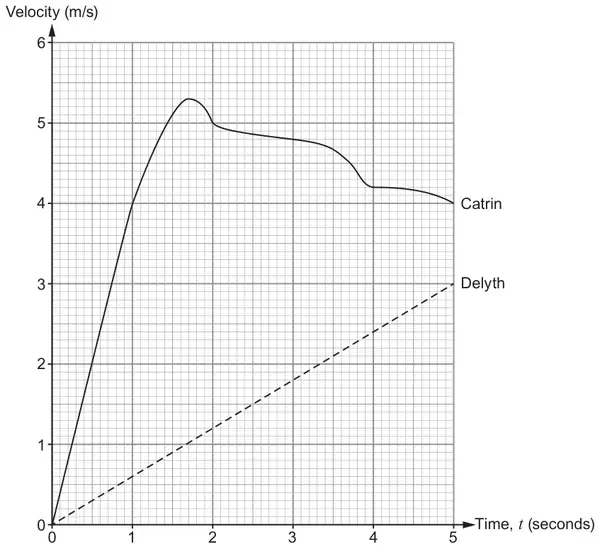
The velocity-time graph shows their velocities over the first 5 seconds of the race.
(a)
After the start of the race, what was the earliest time that Catrin’s acceleration was 0 m/s2? [1]
(b)
Use the trapezium rule to calculate an estimate of the distance Catrin travelled in the first 5 seconds of the race.
Use Catrin’s velocities at times t = 0, t = 1, t = 2, t = 3, t = 4 and t = 5.
You must show all your working. [3]
(c)
(i)
Calculate an estimate of how far Catrin was ahead of Delyth after 5 seconds. [2]
(ii)
Explain why your answer to (c) (i) is an underestimate. [1]
From the formula list: Area of trapezium \(= \dfrac{1}{2}(a+b)h\)
| Scheme | Marks | Comments |
|---|---|---|
| 1·65 to 1·75 (seconds) inclusive | B1 |
| Scheme | Marks | Comments |
|---|---|---|
| Split into at least 5 areas and attempt to sum | M1 | No marks for an unsupported 20 |
| (Area =) ½×1×(0 + 4 + 2(4 + 5 + 4·8 + 4·2)) | M1 | Allow 1 error Or equivalent (Areas of 2, 4·5, 4·9, 4·5, 4·1) (If 10 areas used, areas of 0·5, 1·5, 2·3, ≈ 2·5, ≈ 2·46, ≈ 2·4, ≈ 2·37, ≈ 2·22, ≈ 2·08, ≈ 2·04) Allow 1 slip in reading the scale |
| = 20 (m) | A1 | CAO A1 for an answer of ≈ 20·4 (m) if 10 areas used CAO |
| Scheme | Marks | Comments |
|---|---|---|
| (i) (Distance travelled by Delyth =) ½ × 3 × 5 (=7·5(m)) | B1 | Or full trapezium rule method |
| (Distance apart =) 12·5 (m) | B1 | FT 'their 20' – 7·5 provided first B1 awarded |
| (ii) Reason e.g. ‘Most area calculations for Catrin are underestimates’, or ‘The trapeziums lie under the line’, or ‘The trapeziums cut off bits of the graph’, or ‘The curve is above the area calculated’, or ‘The area of the trapeziums is lower than the area under the curve’ | E1 | Do not accept e.g. ‘Parts of the graph haven’t been used’ ‘Doesn’t include the bumps’ ‘Does not take into account the curvature of the graph’ |