
Higher November 2017 Unit 2 Q3
3. \(ABC\) is an isosceles triangle with \(AB = AC\).
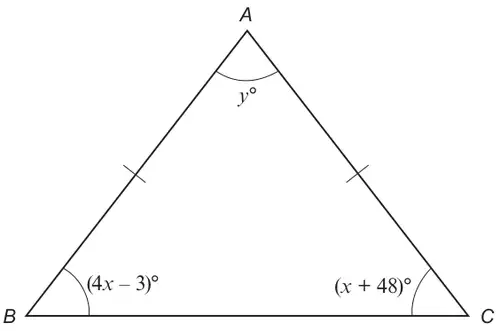
Diagram not drawn to scale
Calculate the value of \(y\). [6]
| Scheme | Marks | Comments |
|---|---|---|
| 4x – 3 = x + 48 | M1 | Look at diagram. |
| 3x = 51 | A1 | |
| x = 17 | A1 | F.T. from ax = b. a ≠ 1. Unsupported x = 17 gains M1A1A1 |
| ABC (or/and ACB) = 65(°) | B1 | F.T. using ‘their derived or stated value for x’ substituted in either (4x – 3) or (x + 48). |
| y = 180 – 2 × 65 | M1 | F.T. 180 – 2 × ‘their 65’ derived using ‘their x’ in either angle’. OR F.T. 180 – ‘their derived ABC’ – ‘their derived ACB’ (Must be using a consistent value for x.) |
| = 50(°) | A1 | A0 if error in either ‘deriving ABC’ or ‘deriving ACB’. A0 if ‘y’ is negative on FT. |
Alternative method
M1A1A1 as before.
| Scheme | Marks | Comments |
|---|---|---|
| y + (4x−3) + (x+48) = 180 or equivalent | B1 | |
| y = 135 − 5×17 | M1 | FT ‘their derived or stated 17’ |
| y = 50(°) | A1 |