
Higher June 2018 Unit 1 Q9
9. In this question, you will be assessed on the quality of your organisation, communication and accuracy in writing.
In the triangle \(ABC\) shown below, \(B\hat{A}C = 40^\circ\) and \(A\hat{C}B = 80^\circ\).
\(X\) is a point on side \(AC\) such that \(BX = BC\).
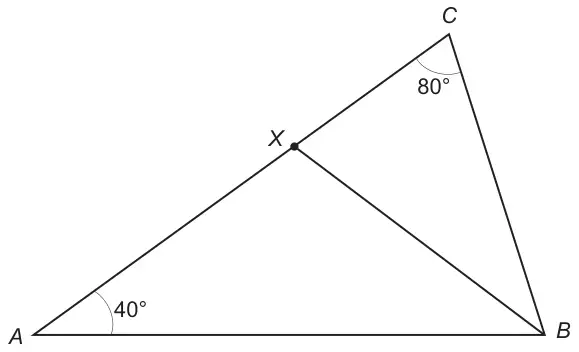
Diagram not drawn to scale
Prove that \(AX = BX\).
Give reasons for each step of your proof.
You must show all your working. [5 + 2 OCW]
| Scheme | Marks | Comments |
|---|---|---|
| Angles shown on the diagram take precedence. If any angle is not named then it must be unambiguously identified either on the diagram, from a given reason or in further work. (e.g. must be convincing that X = 80 is referring to BXC and not AXB.) If initial incorrect assumptions are made then allow correct FT methods to calculate other relevant angles. | ||
| ∠BXC = 80(°) Reason: ‘BX = BC’ OR ‘Isosceles triangle’ | B1 | |
| ∠AXB (= 180 – 80 ) = 100(°) Reason: ‘Angles on a straight line’. | B1 | FT 180 – ‘their ∠BXC’ |
| ∠ABX (= 180 – 40 – 100) = 40(°) Reason: ‘Angles in a triangle’. | B1 | FT 180 – 40 − ‘their ∠AXB’. |
| Statement ‘So AX = BX’, Reason: ‘Two equal angles (in a triangle)’ OR ∠ ABX = ∠BAX OR ‘Isosceles triangle’ | B1 | Only available if ∠ABX stated or shown to be 40(°) |
| Sight of at least TWO of the above reasons. | E1 | Reasons must be appropriate AND are dependent on associated B1 gained. |
| Organisation and Communication. | OC1 | For OC1, candidates will be expected to:
|
| Accuracy of writing. | W1 | For W1, candidates will be expected to:
|
Alternative method 1.
| Scheme | Marks | Comments |
|---|---|---|
| ∠BXC = 80(°) Reason: ‘BX = BC’ OR ‘Isosceles triangle’. | B1 | |
| ∠CBX (= 180 – 80 − 80) = 20(°) Reason: ‘Angles in a triangle’. | B1 | FT 180 – 80 − ‘their ∠BXC’. |
| ∠ABX (= 180 – 80 – 40 – 20) = 40(°) Reason: ‘Angles in a triangle’. | B1 | FT 180 – 80 − 40 − ‘their ∠CBX’. |
| Statement ‘So AX = BX’. Reason: ‘Two equal angles (in a triangle)’ OR ∠ABX = ∠BAX OR ‘Isosceles triangle’ | B1 | Only available if ∠ABX stated or shown to be 40(°) |
| Sight of at least TWO of the above reasons. | E1 | Reasons must be appropriate AND are dependent on associated B1 gained. |
Alternative method 2. (Assumption that AX = BX).
| Scheme | Marks | Comments |
|---|---|---|
| ∠ABX = 40(°) Reason: ‘AX = BX’ OR ‘Isosceles triangle’. | B1 | |
| ∠AXB (= 180 – 40 − 40) = 100(°) Reason: ‘Angles in a triangle’. | B1 | FT 180 – 40 − ‘their ∠ABX’. |
| ∠BXC = 80(°) Reason: ‘Angles on a straight line’. | B1 | FT 180 − ‘their ∠AXB’. |
| Statement ‘So BX = BC’ (as given) Reason: ‘Two equal angles (in a triangle)’ OR ‘∠BXC = ∠BCX’ OR ‘Isosceles triangle’. | B1 | Only available if ∠BXC stated or shown to be 80(°) |
| Sight of at least TWO of the above reasons. | E1 | Reasons must be appropriate AND are dependent on associated B1 gained. |
Alternative method 3. (Assumption that AX = BX).
| Scheme | Marks | Comments |
|---|---|---|
| ∠ABX = 40(°) Reason: ‘AX = BX’ OR ‘Isosceles triangle’. | B1 | |
| ∠CBX (= 180 – 80 – 40 − 40) = 20(°) Reason: ‘Angles in a triangle’. | B1 | FT 180 – 80 – 40 − ‘their ∠ABX’. |
| ∠BXC (= 180 – 80 – 20) = 80(°) Reason: ‘Angles in a triangle’. | B1 | FT 180 – 80 − ‘their ∠CBX’. |
| Statement ‘So BX = BC’ (as given) Reason: ‘Two equal angles (in a triangle)’ OR ‘∠BXC = ∠BCX’ OR ‘Isosceles triangle’. | B1 | Only available if ∠BXC stated or shown to be 80(°) |
| Sight of at least TWO of the above reasons. | E1 | Reasons must be appropriate AND are dependent on associated B1 gained. |