
Higher June 2017 Unit 1 Q12
12. \(A\), \(B\) and \(C\) are points on the circumference of a circle.
\(XY\) is a tangent to the circle at the point \(A\).
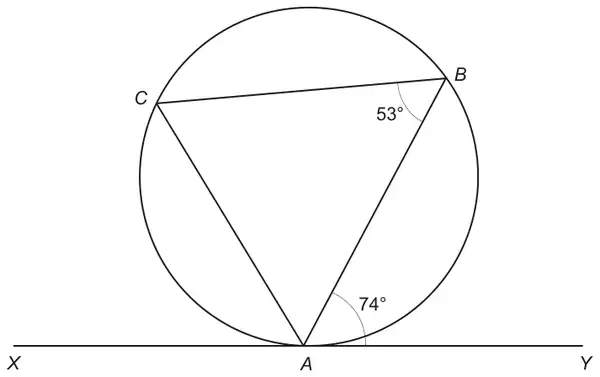
Diagram not drawn to scale
\(B\hat{A}Y = 74^\circ\) and \(A\hat{B}C = 53^\circ\).
Prove that triangle \(ABC\) is an isosceles triangle.
You must give a reason for any statement that you make or any calculation that you carry out. [5]
| Scheme | Marks | Comments |
|---|---|---|
| All ‘E1’ marks are dependent on associated ‘B1’ marks. | ||
| ACB = 74(°) | B1 | By applying the alternate segment theorem. Check diagram. |
| Alternate segment (theorem) | E1 | |
| CAB (= 180 – 53 – 74) = 53(°) | B1 | FT from B1 E0, but not from B0 E0. |
| (Sum of) angles in a triangle (equals 180°) | E1 | |
| Concluding statement e.g. ‘triangle ABC is isosceles as it has two equal angles.’ | E1 | Must justify why the triangle is isosceles i.e. stating (only) ‘triangle is isosceles’ at this stage is insufficient. |
Alternative method
| Scheme | Marks | Comments |
|---|---|---|
| CAX = 53(°) (by applying the alternate segment theorem) | B1 | |
| Alternate segment (theorem) | E1 | |
| CAB (= 180 – 53 – 74) = 53(°) | B1 | |
| (Sum of) angles on a straight line (equals 180°) | E1 | |
| Concluding statement. | E1 |
Be aware of equivalent methods (e.g. drawing a radius to the centre O etc.). These methods must lead to a proof before any marks are awarded.