
Numeracy Higher November 2019 Unit 1 Q11
11. A company makes steel solids that each have a mass of 1 kg.
One of their solids is a square-based pyramid joined to a cuboid as shown below.
The base edges of the pyramid are of length 5 cm, and the height of the cuboid is 4 cm.
The density of the steel used by the company is 8 g/cm3.
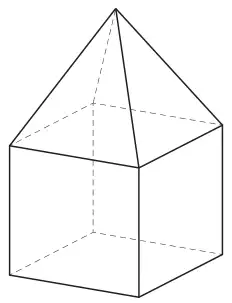
Diagram not drawn to scale
The complete solid has a mass of 1 kg.
Calculate the vertical height of the pyramid. [5]
| Scheme | Marks | Comments |
|---|---|---|
| (Volume needed =) \(\dfrac{1000}{8}\) (= 125 (cm3)) | B1 | May be implied in later working |
| 5×5×4 + \(\dfrac{1}{3}\)×52 × height = \(\dfrac{1000}{8}\) or equivalent | M2 | M1 for:
|
| (height =) \(\dfrac{(125-5\times5\times4)\times 3}{5^2}\) | m1 | Depends on M2 previously awarded A correctly rearranged formula to make ‘height’ the subject |
= 3 (cm) | A1 | CAO |
Alternative
Alternative method:
| Scheme | Marks | Comments |
|---|---|---|
| (Mass of cuboid =) (5 × 5 × 4) × 8 | M1 | |
= 800 (g) | A1 | |
| \(\dfrac{1}{3}\) × 52 × height × 8 = 1000 – 800 or equivalent | M1 | FT ‘their 800’ provided previous M1 awarded |
| (height =) \(\dfrac{200\times 3}{5^2\times 8}\) | m1 | |
= 3 (cm) | A1 | CAO |