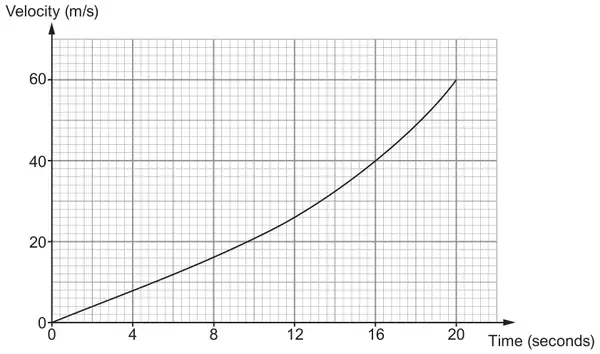
9. The velocity-time graph below shows the velocity of an aircraft for the first 20 seconds of take-off.
(a) Calculate an estimate of the acceleration of the aircraft at time 16 seconds. [3]
(b) Calculate an estimate of the distance travelled by the aircraft during the first 20 seconds of take-off. Use 5 strips of equal width. You must convert your answer into miles. Give your answer as a decimal. [5]
Distance is …………… miles
(c)
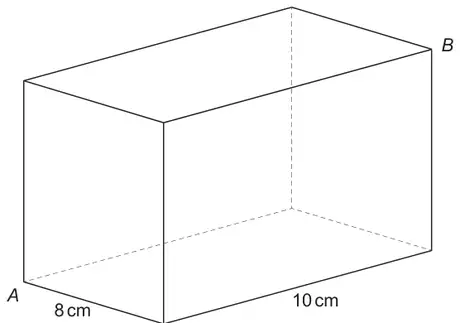
The aircraft carries cargo. One customer wants to use the aircraft to transport a new product that is to be packaged in cuboid boxes, as shown below.
Diagram not drawn to scale
The boxes will meet the following conditions:
The boxes will be of width 8 cm and length 10 cm.
The length of the diagonal AB will be 14 cm.
Calculate the height of a box. Give your answer in the form \(a\sqrt{b}\) cm, where \(a\) and \(b\) are integers, and \(b\) is as small as possible. [6]
From the formula list: Area of trapezium \(= \dfrac{1}{2}(a+b)h\)
Mark scheme (a)
Scheme
Marks
Comments
Tangent drawn at time 16 seconds
M1
Difference in y ÷ difference in x
m1
M1m1A0 if only 1 correct difference in the division
Correctly evaluated gradient from their tangent
A1
ISW Approximately 4 Accept a correct improper fraction (unless it gives a whole number), mixed number or decimal If they give a decimal answer, it needs to be correct to 1 decimal place, rounded or truncated
Each area may be seen as the sum of the area of a rectangle and triangle M1 for the sum of these 5 areas with one error (possibly repeated) in reading the scale
= 480 (m) or equivalent
A1
FT from M1
(480 ÷ 1000) × 5 ÷ 8 OR (480 ÷ 1000) ÷ 1.6 OR (480 ÷ 1000) × 0.625
M1
FT ‘their 480’ provided an attempt made to sum the area of the 5 trapeziums
= 0.3 (miles)
A1
On FT, needs to be correct to 1 decimal place, rounded or truncated
Mark scheme (c)
Scheme
Marks
Comments
82 + 102 or 142 – 102 or 142 – 82 OR \(\sqrt{8^2+10^2}\) or \(\sqrt{14^2-10^2}\) or \(\sqrt{14^2-8^2}\)
M1
\(\sqrt{14^2-(8^2+10^2)}\)
M2
M1 for 142 – (82 + 102). May be seen in stages. Only award this M1 or M2 if ‘their 142 is greater than ‘their (82 + 102)’
(Height =) √32
A1
May be implied by Height2 = 32
= 4√2 (cm)
B2
For B2, FT ‘their derived 32’ provided they have attempted to work with 2 triangles, is of equivalent difficulty, AND their 'b' is as small as possible when in the form a√b
For B1, FT 'their derived 32' B1 for writing 32 as a product of 2 or more factors where one of the factors OR the product of a pair of their factors is a square number e.g. 16 × 2, 2 × 2 × 8, OR B1 for writing √32 as a product of 2 or more factors where one of the factors OR the product of a pair of their factors gives a whole number e.g. √2 × √2 × √8, 2 × √8
We'd like to use Google Analytics cookies to count visits and see which pages help most. They're optional, and the site works exactly the same either way. Privacy policy