
Numeracy Higher June 2025 Unit 2 Q8
8.
A hot air balloon is initially descending at a speed of 3 m/s.
A passenger drops their phone out of the balloon.
The phone accelerates due to gravity at a rate of 9·8 m/s\(^2\), and hits the ground with a speed of 50 m/s.
The speed, \(v\) m/s, of the phone when it hits the ground is given by the formula,
\[v = \sqrt{u^2 + 2gh}\]where:
\(u\) is the initial speed of the phone,
\(g\) is the acceleration due to gravity,
\(h\) is the height above the ground from which the phone was dropped.
Use the formula to calculate the height from which the phone was dropped. [4]
Consider the Earth to be a sphere.
The mass of the Earth is 6·0 × 10\(^{24}\) kg, correct to 2 significant figures.
The volume of the Earth is 1·09 × 10\(^{21}\) m\(^3\), correct to 3 significant figures.
Calculate the greatest possible density of the Earth.
Give your answer in kg/m\(^3\). [3]
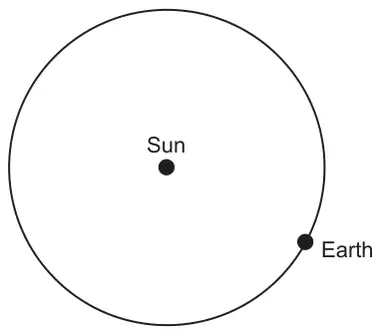
Diagram not drawn to scale
Here are some approximations about the Earth’s motion around the Sun.
- The Earth follows a circular path around the Sun.
- The Earth makes 1 complete revolution of the Sun in 365 days.
- The speed of the Earth is 29 700 m/s.
Use these approximations to calculate the radius, in metres, of the Earth’s motion around the Sun.
Give your answer in standard form. [4]
| Scheme | Mark | Comments |
|---|---|---|
| FT until 2nd error | ||
| \(v^2 = u^2 + 2gh\) or \(50^2 = 3^2 + 2 \times 9.8 \times h\) | B1 | or equivalent, e.g. 2500 = 9 + 19.6h Do not allow any FT if:
|
| \(v^2 - u^2 = 2gh\) or \(50^2 - 3^2 = 2 \times 9.8 \times h\) | B1 | |
| \(\dfrac{v^2 - u^2}{2g} = h\) or \(\dfrac{50^2 - 3^2}{2 \times 9.8} = h\) | B1 | |
| (\(h\) =) 127(.091…) or 127.1 (m) | B1 | If an unsupported 127(.091…) or 127.1 seen, allow B1B1B1B1 On FT, only award this final B1 if \(h\) > 0 |
| Scheme | Mark | Comments |
|---|---|---|
| Use of 6.05 × 10\(^{24}\) AND 1.085 × 10\(^{21}\) | B1 | Accept use of 6.0499(…) × 10\(^{24}\) for 6.05 × 10\(^{24}\) throughout Do not allow use of 6.049 × 10\(^{24}\) |
| (Greatest possible density =) (6.05 × 10\(^{24}\)) ÷ (1.085 × 10\(^{21}\)) | M1 | If B0, FT provided unambiguously chosen: 6.0 × 10\(^{24}\) < ‘their 6.05 × 10\(^{24}\)‘ ≤ 7 × 10\(^{24}\) and 1 × 10\(^{21}\) ≤ ‘their 1.085 × 10\(^{21}\)’ < 1.09 × 10\(^{21}\) |
| = 5576(.03…) (kg/m\(^3\)) or equivalent | A1 | CAO Allow an answer of 5580 provided no incorrect work seen ISW |
| Scheme | Mark | Comments | |
|---|---|---|---|
| (Distance travelled by the Earth in 1 year =) 29700 × 365 × 24 × 60 × 60 or 29700 × 31536000 (= 936 619 200 000 or 9.366192 × 10\(^{11}\)) | M2 | Allow use of 365.25 for all marks M1 for correct use of 29700 with any 3 of 365, 24, 60 and 60, which may be embedded in further incorrect working If no evidence of 29700 × 365, allow M1 to be implied by a value in the range 9 × 10\(^{11}\) to 9.7 × 10\(^{11}\)
| |
| (Radius of Earth’s motion around the Sun =) \(\dfrac{29700 \times 365 \times 24 \times 60 \times 60}{(2 \times)\ \pi}\) or \(\dfrac{936\,619\,200\,000}{(2 \times)\ \pi}\) | M1 | FT ‘their 936 619 200 000‘ provided it comes from a calculation that includes 29700 × 365 OR FT if no evidence of 29700 × 365 but ‘their 936 619 200 000‘ is in the range 9 × 10\(^{11}\) to 9.7 × 10\(^{11}\) Do not award this M1 if this calculation is then square rooted Accept values of \(\pi\) from 3.14 to 3.142 | |
| = 1.49 × 10\(^{11}\) to 1.5 × 10\(^{11}\) (m) | A1 | FT from M1M1 Must be correct for \(\dfrac{\text{‘their }936\,619\,200\,000\text{’}}{2 \times \pi}\) AND be written in standard form On FT, accept truncation or rounding of the mantissa |