(a) Geraint has bought a new front cog for his bike.
The cog has a mass of 150 g, correct to the nearest 10 g. The cog has been made from a metal that has a density of 3 g/cm3, correct to the nearest g/cm3. Calculate the maximum possible volume of the cog. [3]
(b) This picture shows part of Geraint’s bike.
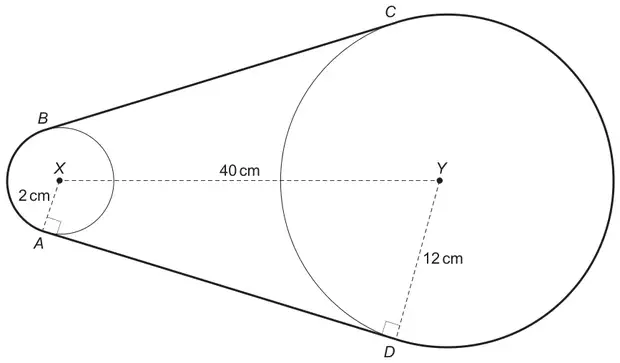
A simplified diagram of the cogs and the chain is shown below.
Diagram not drawn to scale
X and Y are the centres of the cogs and XY is a line of symmetry. BC and AD are straight sections of the chain.
The larger cog has a radius of 12 cm. The smaller cog has a radius of 2 cm.
(i) Use Pythagoras’ theorem to show that the length of AD is \(10\sqrt{15}\) cm. You must show all your working. [3]
(ii)
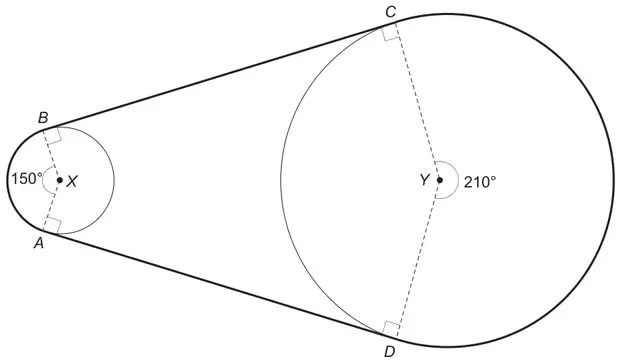
Diagram not drawn to scale
\(A\hat{X}B\) = 150º, reflex \(C\hat{Y}D\) = 210º, BC = AD = \(10\sqrt{15}\) cm.
Calculate the total length of the chain.
Give your answer in the form \(a\sqrt{15} + b\pi\), where \(a\) and \(b\) are rational numbers. [5]
Mark scheme (a)
Scheme
Marks
Comments
Use of Volume = \(\dfrac{\text{Mass}}{\text{Density}}\)
B1
(Maximum possible volume =) \(\dfrac{155}{2.5}\)
M1
FT ‘their 155’ provided 150 < mass < 160 AND ‘their 2.5’ provided 2 < density < 3
= 62 (cm3)
A1
CAO
If no marks awarded, SC1 for use of 155 AND 2.5
Mark scheme (b)
(i)
Scheme
Marks
Comments
Identification of correct right-angled triangle
B1
May be implied by sight of 40 AND (12 – 2) or 10 in working
(AD2 =) 402 – (12 – 2)2 or (AD2 =) 402 – 102
M1
AD2 = 1500 OR (AD =) \(\sqrt{1500}\) AND (AD =) \(10\sqrt{15}\) (cm)
A1
Sight of AD2 = 1500 OR (AD =)\(\sqrt{1500}\) AND \(10\sqrt{15}\) need to be seen
Allow values of π from 3.14 to 3.142 for M marks only
Or equivalent M1 for \(\dfrac{150}{360}\) × 2 × π × 2 OR \(\dfrac{210}{360}\) × 2 × π × 12 or equivalents
= \(15\frac{2}{3}\pi\) or \(\dfrac{5640\pi}{360}\) or \(\dfrac{47\pi}{3}\) (cm) or equivalent
A2
CAO. Allow 15.66π, 15.67π or 15.7π A1 for any one of the following:
AB = 600π/360 or equivalent (= 5π/3 or 12/3π), allowing 1.66π, 1.67π or 1.7π
CD = 5040π/360 or equivalent (=14π or 42π/3)
On FT from M1 for a correct evaluation of ‘their \(\dfrac{150}{360}\)×2×π×2 + \(\dfrac{210}{360}\)×2×π×12’ with 1 correct term, accepting similar notation possibilities as A2
(Total length of chain =) \(20\sqrt{15}\) + \(\dfrac{5640\pi}{360}\) (cm) or equivalent
B1
ISW Accept use of \(15\frac{2}{3}\pi\) Allow use of 15.66π, 15.67π or 15.7π FT ‘their 5640π/360’ provided at least 2 marks previously awarded
If no marks awarded, and from using π × radius in their calculations, i.e. using the method 2×\(10\sqrt{15}\) + \(\dfrac{150}{360}\)×π×2 + \(\dfrac{210}{360}\)×π×12 SC3 for an answer of \(20\sqrt{15}\) + \(\dfrac{5640\pi}{720}\) (cm) or equivalent, allowing use of 7.83(…)π OR SC2 for … + \(\dfrac{5640\pi}{720}\) (cm) or equivalent, allowing use of 7.83(…)π OR SC1 for use of 2×\(10\sqrt{15}\) + \(\dfrac{150}{360}\)×π×2 + \(\dfrac{210}{360}\)×π×12
We'd like to use Google Analytics cookies to count visits and see which pages help most. They're optional, and the site works exactly the same either way. Privacy policy