
Higher November 2024 Unit 2 Q20
20. In the shape shown below, \(CD\) = 6 cm, \(CH\) = 7 cm and \(GH\) = 5 cm.
\(C\hat{G}H = x\).
\(GH\) is the radius of the circle with centre \(G\).
\(CDG\) is a straight line.
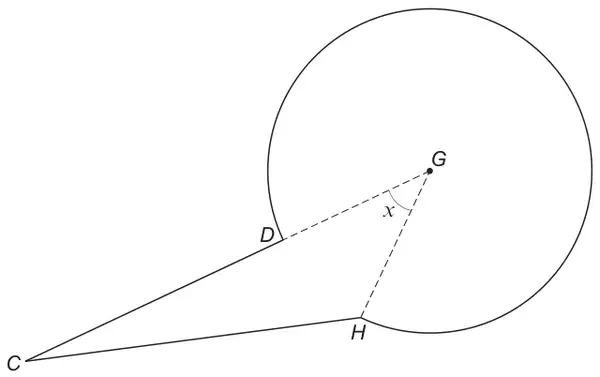
Diagram not drawn to scale
(a) Calculate the size of angle \(x\). [3]
Angle \(x\) = ………… °
(b) Hence, calculate the total area of the shape. [5]
From the formula list: In any triangle \(ABC\): Sine rule \(\dfrac{a}{\sin A} = \dfrac{b}{\sin B} = \dfrac{c}{\sin C}\); Cosine rule \(a^2 = b^2 + c^2 - 2bc\cos A\); Area of triangle \(= \dfrac{1}{2}ab\sin C\)
| Scheme | Marks | Comments | ||||||
|---|---|---|---|---|---|---|---|---|
| (\(\cos x\) =) \((5^2 + 11^2 - 7^2) / (2 \times 5 \times 11)\) (= 97/110 OR 0·8818… ) | M2 | An incorrect trigonometric ratio explicitly stated in the solution is M0, e.g., \(\sin x = (5^2 + 11^2 - 7^2) / (2 \times 5 \times 11)\) M1 for \(7^2 = 5^2 + 11^2 - 2 \times 5 \times 11 \cos x\) | ||||||
| (\(x\) = ) 28·1(…°) | A1 | Allow an answer of 28(°) from correct working.
|
Alternative method by first calculating \(G\hat{C}H\)
| Scheme | Marks | Comments | ||||||
|---|---|---|---|---|---|---|---|---|
| A correct and complete method first using the cosine rule to calculate \(G\hat{C}H\) and then using the sine rule to calculate \(x\). (\(\cos G\hat{C}H\) =) \((7^2 + 11^2 - 5^2) / (2 \times 7 \times 11)\) (= 145/154 OR 0·9415… ) (\(G\hat{C}H\) = ) 19·6(…°) (\(\sin x\) =) \(7 \times \sin(G\hat{C}H) / 5\) (= 0.4715…) | M2 | A partial method is M0.
| ||||||
| (\(x\) = ) 28·1(…°) | A1 |
|
Alternative method by first calculating \(C\hat{H}G\)
| Scheme | Marks | Comments | ||||||
|---|---|---|---|---|---|---|---|---|
| A correct and complete method first using the cosine rule to calculate \(C\hat{H}G\) and then using the sine rule to calculate \(x\). (\(\cos C\hat{H}G\) =) \((5^2 + 7^2 - 11^2) / (2 \times 5 \times 7)\) (=−47/70 OR −0·67(14…) ) (\(C\hat{H}G\) = ) 132·1(…°) (\(\sin x\) =) \(7 \times \sin(C\hat{H}G) / 11\) (= 0.4715…) | M2 | A partial method is M0.
| ||||||
| (\(x\) = ) 28·1(…°) | A1 |
|
| Scheme | Marks | Comments |
|---|---|---|
| (Area of triangle = ) \(\frac{1}{2} \times 5 \times 11 \times \sin[28{\cdot}1(\ldots)]\) | M1 | FT ‘their derived \(x\)’. If CG=6cm is consistently used in part (a), allow a FT with length CG=6cm. |
| = 12·9(…cm2) or 13(cm2) | A1 | |
| (Major sector area = ) \((360 - 28{\cdot}1(\ldots)) / 360 \times \pi \times 5^2\) OR (Area of circle AND Minor sector area = ) \(\pi \times 5^2\) AND \(28{\cdot}1/360 \times \pi \times 5^2\) | M1 | FT ‘their stated or derived \(x\)’. |
| 72·36(cm2) to 72·42(cm2) OR 78·5(cm2) to 78·6(cm2) AND 6·1(…cm2) | A1 | |
| [Total area = 12·9(…) + 72·4(…) =] OR [Total area = 12·9(…) + 78·5(…) – 6·1(…)=] Answer in the range 85·26 to 85·5(cm2) | B1 | FT ‘their derived 12·9(…cm2)’ and ‘their derived 72·4(…cm2)’ OR ‘their derived 12·9(…cm2)’ and ‘their derived 78·5(…cm2)’ AND ‘their derived 6·1(…cm2)’, provided previous M1M1 awarded. |