
Higher November 2024 Unit 1 Q12
12. The diagrams below show a solid cone and a circle.
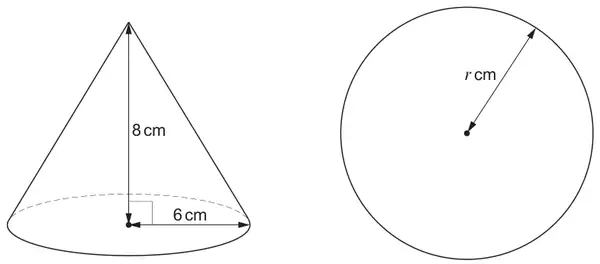
Diagrams not drawn to scale
The cone has a base radius of 6 cm and a vertical height of 8 cm.
The circle has a radius of \(r\) cm.
The curved surface area of the cone equals the area of the circle.
By expressing any areas in terms of \(\pi\), find the value of \(r\).
Give your answer in the form \(a\sqrt{b}\),where \(a\) and \(b\) are integers, and \(b\) is as small as possible. [6]
From the formula list: Curved surface area of cone \(= \pi r l\)
| Scheme | Marks | Comments |
|---|---|---|
| (Slant height of cone =) \(\sqrt{6^2 + 8^2}\) | M1 | Method for finding hypotenuse. Accept use of (3,4,5) x 2. |
| = 10 (cm) | A1 | |
| (Curved surface area of cone =) \(\pi \times 6 \times 10\) | M1 | FT ‘their derived slant height’ (not 8). |
| = \(60\pi\) (cm2) or equivalent | A1 | CAO [For reference, \(60\pi\) = 188.4] \(60\pi\) may be implied by later working (e.g. sight of \(r^2\) = 60) For calculating the total surface area of the cone, award M1 A1 SC1 for an answer of \(96\pi\) (cm2) [= 301(.44)] (from including the area of the base of the cone) |
| (\(\pi r^2 = \pi \times 6 \times 10\)) \(r^2\) = 60 or \(r = \sqrt{60}\) or equivalent | M1 | Isolating \(r^2\) or \(r\). FT for ‘their \(r^2\) = 60’ or ‘their \(r = \sqrt{60}\)’ from \(\pi r^2\) = ‘their \(60\pi\)’ |
| \((r =)\) \(2\sqrt{15}\) | A1 | FT from \(r^2 = k\), provided equivalent difficulty (with \(r\) in the form \(a\sqrt{b}\), where \(a\) and \(b\) are integers, and \(b\) is as small as possible). SC1 for r = \(\sqrt{6L}\) (where \(L\) = slant height) Note: after M0A0M0A0 for use of 8 as the slant height \(r^2\) = 48 or \(r = \sqrt{48}\) M1 \((r =)\) \(4\sqrt{3}\) A1 |
Corrected by Westie's Workshop
- The board's mark scheme printed “as small as possible’).”. Changed to “as small as possible).” because there is a stray closing quotation mark before the bracket.
Original: see the board's mark scheme PDF (link above).