
May 2026 Paper 1 Q12
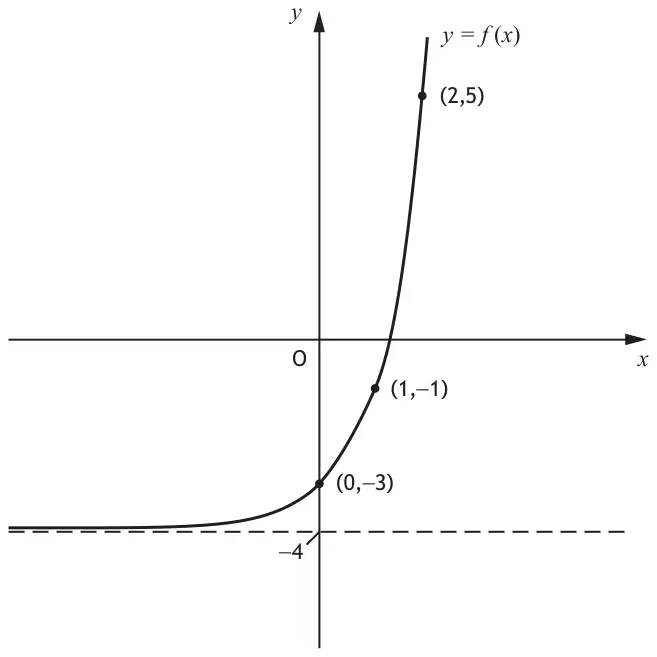
12. An exponential function, \(f\), is defined for \(x\in\mathbb{R}\).
The diagram shows the graph of \(y=f(x)\).
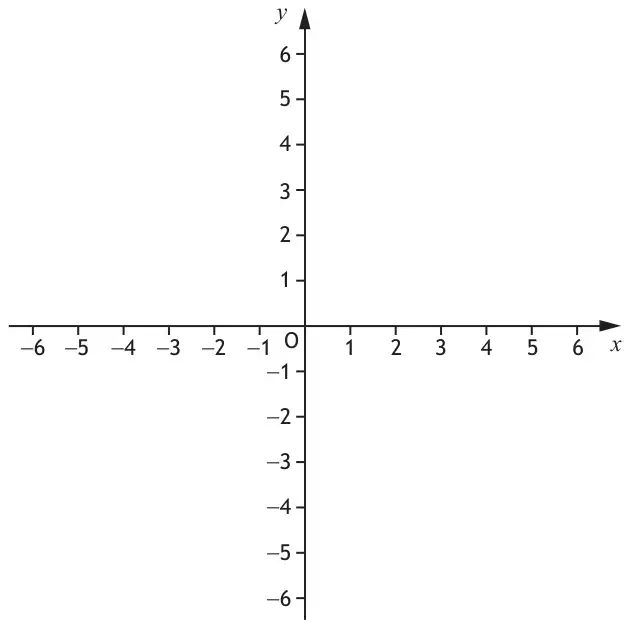
The inverse function, \(f^{-1}(x)\), exists.
The inverse function is of the form \(f^{-1}(x)=\log_a(x+b)\).
| Mark | Generic scheme | Illustrative scheme |
|---|---|---|
| •1 | graph reflected in \(y=x\) i.e. generally increasing for \(-3\leqslant x\leqslant5\) and passing through (−3,0), (−1,1) and (5,2) | •1, •2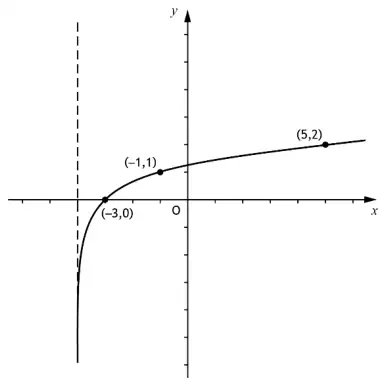 |
| •2 | increasing for \(x\lt-3\) (and for \(x\gt5\)) and approaching \(x=-4\) from the right | |
| (2) |
Notes:
- •1 is not available where the graph has a maximum turning point where \(-1\lt x\lt5\) and •2 is not available where the graph has a maximum turning point where \(5\leqslant x\leqslant6\).
- •2 is only available where •1 has been awarded.
- The line \(x=-4\) does not need to be shown.
- For a rotation, award 0/2 – for example see Candidate A.
- Do not penalise graphs which do not extend beyond (5,2).
Commonly Observed Responses:
Candidate A - rotation about O
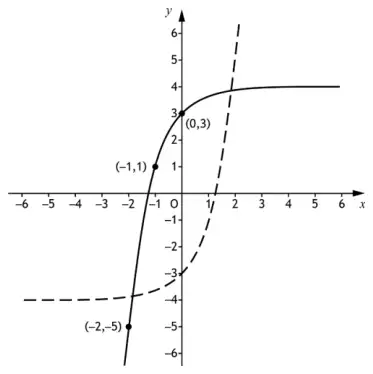 | •1 ✗ •2 ✗ |
No further marks in this question can be inferred from this graph.
In part (b), candidates may work with the original graph and gain full marks for \(b=4\) and \(a=3\) (with or without working) and \(x\gt-4\).
Candidate B - reflection in \(x\)-axis
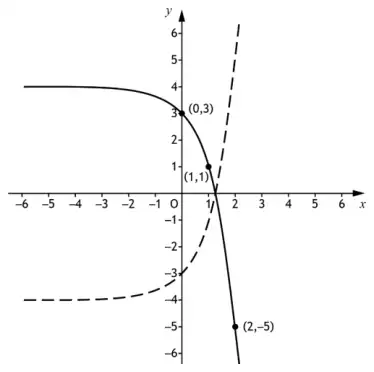 | •1 ✗ •2 ✗ |
No further marks in this question can be inferred from this graph.
In part (b), candidates may work with the original graph and gain full marks for \(b=4\) and \(a=3\) (with or without working) and \(x\gt-4\).
| Mark | Generic scheme | Illustrative scheme |
|---|---|---|
| •3 | determine value of \(b\) | \(b=4\) |
| •4 | determine value of \(a\) | \(a=3\) |
| (2) |
| Mark | Generic scheme | Illustrative scheme |
|---|---|---|
| •5 | state domain | \(x\gt-4,\quad(x\in\mathbb{R})\) |
| (1) |
Notes:
- \(a\) and \(b\) may be calculated independently of each other.
- The values of \(a\) or \(b\) can be calculated using \(a=b-1\) where \(b\gt1\).
- Accept ‘\(f(x)\gt-4\)’ for •5.
- For •5, the domain can be calculated using \(x\gt-b\).
- For •5, do not penalise the omission of \(x\in\mathbb{R}\).
- For •5, the domain can be from the original graph, the candidate’s transformed graph or from the value of \(b\) in (b)(i). However, refer back to Candidates A and B.
Commonly Observed Responses:
Candidate C - Values of \(a\) and \(b\) in equation
| \(\log_3(x+4)\) | •3 ✓ •4 ✓ |
Candidate D - Incorrect values of \(a\) and \(b\)
| \(\log_3(x+4)\) | •3 ✗ |
| \(b=3\) | •4 ✗ |
| \(x\gt-3\) | •5 ✓1 |