
May 2024 Paper 2 Q10
10. The circle C1 has equation \(x^2+y^2+18x-2y-8=0\).
(a) Find the centre and radius of C1. [2]
A second circle, C2, touches C1 internally.
The centre of C2 is (−6, 0).
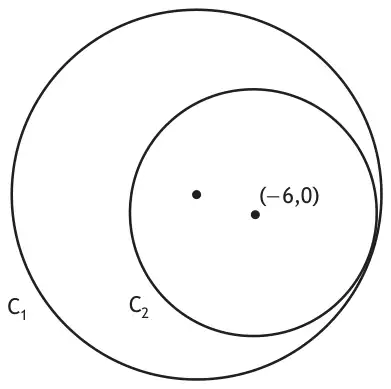
(b) Determine the equation of C2. [2]
| Mark | Generic scheme | Illustrative scheme |
|---|---|---|
| •1 | state centre | \((-9,1)\) |
| •2 | calculate radius | \(\sqrt{90}\) or \(3\sqrt{10}\) or \(9.48\ldots\) |
| (2) |
Notes:
- Accept \(x=-9,\ y=1\) for •1.
- Do not accept ‘\(g=-9, f=1\)’ or ‘\(-9,1\)’ for •1.
- Do not penalise candidates who treat negative signs with a lack of rigour when calculating the radius. For example accept \(\sqrt{9^2+-1^2+8}=\sqrt{90}\) or \(\sqrt{9^2+1^2+8}=\sqrt{90}\) or \(\sqrt{-9^2+1^2+8}=\sqrt{90}\) for •2. However, do not accept \(\sqrt{9^2-1^2+8}=\sqrt{90}\) for •2.
| Mark | Generic scheme | Illustrative scheme |
|---|---|---|
| •3 | determine the distance between the centres and subtract to find a numerical expression for the radius of C2 | eg \(\sqrt{90}-\sqrt{10}\) |
| •4 | determine equation of C2 | \((x+6)^2+y^2=40\) |
| (2) |
Notes:
- Do not penalise the use of decimals.
- The distance between the centres, and the radius of C2 must be consistent with the sizes of the circles in the original diagram (\(d<r_{\text{C}_2}<r_{\text{C}_1}\)).
- Where a candidate uses an incorrect radius without supporting working, •4 is not available.
Commonly Observed Responses:
Candidate A - follow-through marking
| Part (a) | |
| \(r=\sqrt{74}\) | •2 ✗ |
| Part (b) | |
| \(d=\sqrt{10}\) | |
| radius \(=\sqrt{74}-\sqrt{10}\) | •3 ✓1 |
| \((x+6)^2+y^2=5.44\ldots^2\) | |
| \((x+6)^2+y^2=29.59\ldots\) (or \(84-4\sqrt{185}\)) | •4 ✓1 |
Candidate B - using line through centres
| Equation of radius: \(3y=-x-6\) | |
| \((-3y-6)^2+y^2+18(-3y-6)-2y-8=0\) | |
| \(10y^2-20y-80=0\) | |
| \(\cancel{y=4}\qquad y=-2\) | |
| \(\cancel{x=-18}\qquad x=0\) | |
| Radius = distance between \((-6,0)\) and \((0,-2)\) | |
| Radius = \(\sqrt{40}\) | •3 ✓ |
| \((x+6)^2+y^2=40\) | •4 ✓ |