
June 2025 Unit 4 Q8
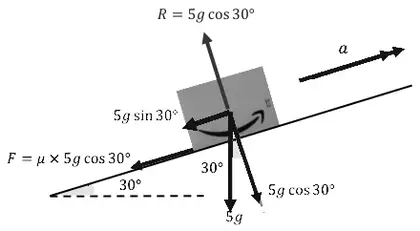
8. An object, of mass 5 kg, is projected up the line of greatest slope of a rough plane inclined at an angle of \(30^\circ\) to the horizontal.
(a) Given that the deceleration of the object up the plane is 6·3 ms−2, show that the coefficient of friction between the plane and the object is \(\dfrac{2\sqrt3}{21}\). [5]
(b) Determine whether the object will remain stationary on the plane immediately after it comes to rest. [2]
| Scheme | Marks | Comments |
|---|---|---|
| Perpendicular to plane: \(R=5g\cos30^\circ\qquad\left(=\tfrac{5\sqrt3}{2}g=\tfrac{49\sqrt3}{2}=42{\cdot}435\ldots\right)\) | B1 | si, any form |
| Apply N2L up slope, upwards positive \(0\pm5g\sin30^\circ\pm F=\pm5a\) | M1 | Dim. correct, no missing/extra forces Any signs, allow \(5g\cos30^\circ\) |
| \(0-5g\sin30^\circ-F=5a\) \(-24{\cdot}5-F=5(-6{\cdot}3)\) \(-24{\cdot}5-F=-31{\cdot}5\qquad\Rightarrow\qquad F=7\) | A1 | oe \(5g\sin30^\circ+F=5a\) with \(a=6{\cdot}3\) |
| \(F=\mu R\qquad\left(7=\tfrac{5\sqrt3}{2}g\mu=\tfrac{49\sqrt3}{2}\mu=42{\cdot}435\ldots\mu\right)\) \(\mu=\dfrac{7}{\frac{5g\sqrt3}{2}}=\dfrac{2}{7\sqrt3}\) | M1 | Used, si, \(F=(5g\cos30^\circ)\mu\) \(\mu R=7\) |
| \(\mu=\dfrac{2\sqrt3}{21}\) \((\mu=0{\cdot}1649\ldots)\) | A1 | Convincing |
| [5] |
| Scheme | Marks | Comments |
|---|---|---|
| Maximum friction (up slope) \(F=\mu R=\tfrac{2\sqrt3}{21}\times5g\cos30^\circ=\tfrac57g=7\) | From part (a) | |
| Component of weight (down slope) \(=5g\sin30^\circ=\tfrac52g=\tfrac{49}{2}=24{\cdot}5\) Reference to weight and friction Component of weight \(>\) Friction | M1 | \(24{\cdot}5>7\) \(24{\cdot}5\neq7\) |
| A clear concluding statement For example, the object will
| A1 | Convincing |
| [2] | ||
| [7] | Total for Question |