
Higher November 2017 Paper 2 Q9
9. The diagram below shows triangle ABC.
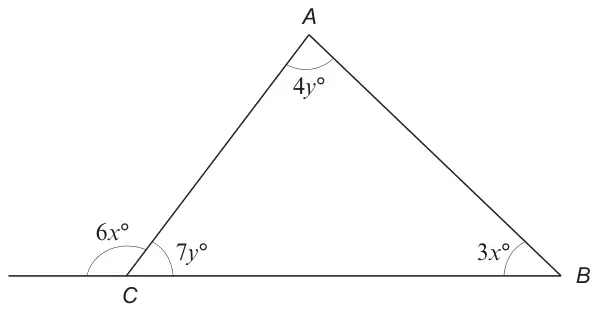
Diagram not drawn to scale
(a) Use the angles in the triangle to complete the following equation. [1]
\(3x + 11y = \ldots\ldots\ldots\ldots\)
(b) Use the angles on the straight line at C to obtain a further equation.
Use the two equations to show that ABC is an isosceles triangle.
You must use an algebraic method. [6]
Use the two equations to show that ABC is an isosceles triangle.
You must use an algebraic method. [6]
| Scheme | Marks | Comments |
|---|---|---|
| \((3x + 11y =)\ 180\) | B1 |
| Scheme | Marks | Comments |
|---|---|---|
| \(6x + 7y = 180\) | B1 | |
| Method to eliminate variable, e.g. equal coefficients and method to find second variable | M1 | FT provided at least one equation is correct and the other is of equivalent difficulty. Allow 1 error in one term, not one with equal coefficients |
| First variable | A1 | \(x = 16\) or \(y = 12\) |
| Second variable OR (from 1st variable \(y = 12\)) \(3x = 48\) | A1 | FT their first variable provided M1 previously awarded |
| Decision to evaluate (\(7y\) (=84),) \(4y\) (=48) and \(3x\) (=48) with a conclusion, e.g. ‘\(ABC\) is an isosceles triangle as \(4y = 3x = 48\)’ | E2 | CAO, not FT. Accept ‘therefore’ as a conclusion correct angles stated FT for award of E1 only, for an attempt to evaluate at least \(4y\) with \(3x\) using ‘their \(x\)’ and ‘their \(y\)’ |
| (7) |
Alternative
| \(6x + 7y = 180\) | B1 |
| \(6x + 7y = 3x + 11y\) or \(6x = 4y + 3x\) or equivalent | M1 |
| \(6x - 3x = 11y - 7y\) or \(6x - 3x = 4y\) | A1 |
| (so) \(3x = 4y\) | A1 |
| Conclusion that this gives 2 equal angles in the triangle (so it is isosceles) | E2 |