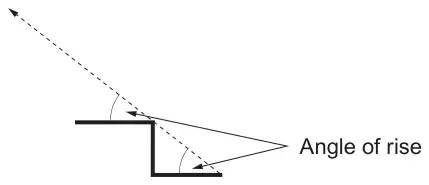
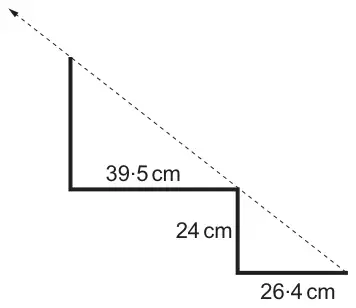
13. Eleri goes on holiday to visit historic gardens in Italy. In many of the gardens she notices irregular staircases. Each staircase has horizontal steps and vertical rises.
The angle of rise is measured from the horizontal upwards.
(a) The bottom step on a staircase is 26·4 cm wide with a vertical rise of 24 cm. The second step in this staircase is 39·5 cm wide and has the same angle of rise.
Diagram not drawn to scale
(i) Calculate the angle of rise. [2]
(ii) Hence use trigonometry to calculate the vertical rise of the second step in centimetres. Give your answer correct to 2 significant figures. You must show all your working. [2]
(b) Look again at the diagram and your method of using trigonometry, in part (a).
Show how the vertical rise of the second step could be calculated without the use of trigonometry. You must show all your working. (A scale drawing is not acceptable, as you are asked to calculate.)
Evaluate which was the most efficient method of calculating the vertical rise of the second step. [3]
Mark scheme (a)
Scheme
Marks
Comments
(i) \(\tan \text{rise} = 24/26.4\) or angle of rise \(= \tan^{-1} 24/26.4\)
M1
Trigonometry must be used in (a)
\(42(.27\ldots^\circ)\)
A1
(ii) \(\tan 42(.27\ldots^\circ) = 2^{\text{nd}}\text{ rise}/39.5\) or \(2^{\text{nd}}\text{ rise} = 39.5 \times \tan 42(.27\ldots^\circ)\)
M1
FT ‘their angle of rise’ provided M1 previously awarded
(\(2^{\text{nd}}\) rise =) 36 (cm)
A1
Must be 2 sig. figs. Do not accept an unsupported answer of 36 (cm), trigonometry must be seen
Mark scheme (b)
Scheme
Marks
Comments
\(2^{\text{nd}}\text{ rise}/39.5 = 24/26.4\) or \(2^{\text{nd}}\text{ rise} = 39.5 \times 24/26.4\) or \(2^{\text{nd}}\text{ rise} = 39.5 \times 0.9(090\ldots)\) or \(2^{\text{nd}}\text{ rise} = 39.5 \div 1.1\) or equivalent
M1
Must show ratio or similar triangle working, not the use of ‘tan’ Accept use of scale factor method
35.9(... cm) or 36 (cm) AND an evaluation, e.g. ‘similar triangles as fewer stages’, ‘non trigonometry method as few stages, so less chance of making a mistake’
A2
MUST FT from working A1 for 36 (cm) or 35.9(...cm) OR for an evaluation
We'd like to use Google Analytics cookies to count visits and see which pages help most. They're optional, and the site works exactly the same either way. Privacy policy