
Higher November 2021 Paper 2 Q20
20. The diagram shows the journey of a small boat.
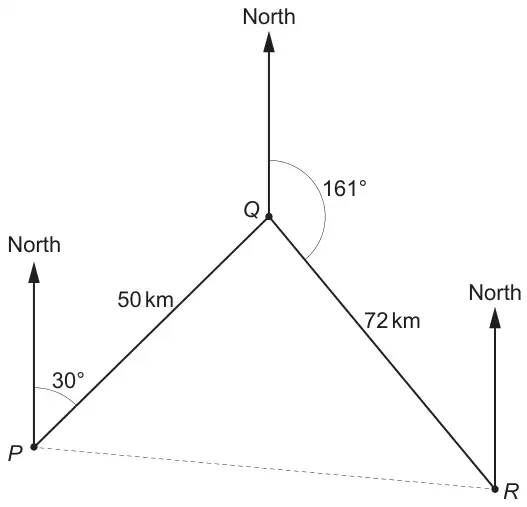
Diagram not drawn to scale
The boat sails from point \(P\) on a bearing of 030° for 50 km.
When it reaches point \(Q\), it changes direction and travels to point \(R\) on a bearing of 161° for 72 km.
(a) Show that \(P\hat{Q}R = 49^\circ\). [1]
(b) The triangular area \(PQR\) is to be searched to locate a shipwreck.
Calculate this area. [2]
Calculate this area. [2]
(c) Calculate the bearing of \(P\) from \(R\).
Give your answer correct to the nearest degree. [7]
Give your answer correct to the nearest degree. [7]
| Scheme | Marks | Comments |
|---|---|---|
| Correct justification e.g. 360 – 150 – 161 (= 49°) or 180 – 161 + 30 (= 49°) | B1 | or equivalent; check diagram; NB method must be seen as answer is given Allow 30 + 19 (= 49) |
| Scheme | Marks | Comments |
|---|---|---|
| \(\dfrac{1}{2} \times 50 \times 72 \times \sin 49\) | M1 | |
| 1358(.4772…km\(^2\)) | A1 |
| Scheme | Marks | Comments |
|---|---|---|
| \(PR^2 = 2960(.37…)\) | M2 | M1 for \(PR^2 = 50^2 + 72^2 - 2(50)(72)\cos 49\) |
| \(PR = 54.4(…\text{ km})\) | A1 | soi; accept 54 km |
| \(\cos PRQ = \dfrac{54.4^2 + 72^2 - 50^2}{2 \times 54.4… \times 72}\) or \(\sin PRQ = 50 \times \dfrac{\sin 49}{54.4…}\) or \(\cos QPR = \dfrac{54.4^2 + 50^2 - 72^2}{2 \times 54.4… \times 50}\) or \(\sin QPR = 72 \times \dfrac{\sin 49}{54.4…}\) or | M2 | FT ‘their 54.4….’ for M2 or M1 M1 for \(50^2 = 54.4…^2 + 72^2 - 2(54.4…)(72)\cos PRQ\) or for \(\dfrac{\sin PRQ}{50} = \dfrac{\sin 49}{54.4…}\) soi; may be inverted or for \(72^2 = 54.4…^2 + 50^2 - 2(54.4…)(50)\cos QPR\) or for \(\dfrac{\sin QPR}{72} = \dfrac{\sin 49}{54.4…}\) soi; may be inverted |
| \(PRQ = 44^\circ\) or \(QPR = 87^\circ\) | A1 | CAO; Accept 43.9(…) or 87.0(…) |
| Bearing is (360 – 44 – 19 = ) 297° or (180 + 30 + 87 = ) 297° | A1 | FT ‘their derived 44’ or ‘their derived 87’ |
Alternative method using area
| Scheme | Marks | Comments |
|---|---|---|
| \(PR^2 = 2960(.37…)\) | M2 | M1 for \(PR^2 = 50^2 + 72^2 - 2(50)(72)\cos 49\) |
| \(PR = 54.4(…\text{ km})\) | A1 | soi; accept 54 km |
| \(\sin QRP = \dfrac{1358 \times 2}{54.4… \times 72}\) or \(\sin QPR = \dfrac{1358 \times 2}{54.4… \times 50}\) | M2 | FT ‘their 1358’ and ‘their 54.4….’ for M2 or M1 M1 for \(\dfrac{1}{2} \times 54.4… \times 72 \times \sin QRP = 1358\) or for \(\dfrac{1}{2} \times 54.4… \times 50 \times \sin QPR = 1358\) |
| \(PRQ = 44^\circ\) or \(QPR = 87^\circ\) | A1 | CAO; Accept 43.9(…) or 87.0(…) |
| Bearing is (360 – 44 – 19 = ) 297° or (180 + 30 + 87 = ) 297° | A1 | FT ‘their derived 44’ or ‘their derived 87’ |
| (10) |
Corrected by Westie's Workshop
- The board's mark scheme printed “\(2 \times 54.4… \times 72\)”. Changed to “\(2 \times 54.4… \times 50\)” because angle \(QPR\) is between the sides 54.4… km and 50 km, so the cosine rule uses \(2 \times 54.4… \times 50\). This gives the 87° in the mark scheme.
- The board's mark scheme printed “\(2(54.4…)(72)\cos QPR\)”. Changed to “\(2(54.4…)(50)\cos QPR\)” because angle \(QPR\) is between the sides 54.4… km and 50 km, so the cosine rule uses \(2(54.4…)(50)\).
Original: see the board's mark scheme PDF (link above).