
Higher November 2020 Paper 2 Q16
16.
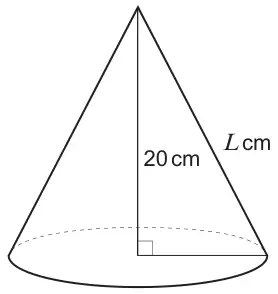
Diagram not drawn to scale
(a) A cone has vertical height 20 cm.
The volume of the cone is 2400 cm3.
Calculate \(L\), the slant height of the cone. [4]
The volume of the cone is 2400 cm3.
Calculate \(L\), the slant height of the cone. [4]
(b) Cones \(A\) and \(B\) are mathematically similar.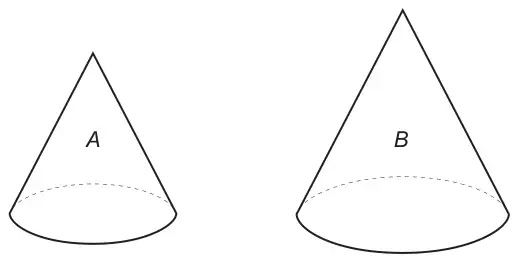
Diagram not drawn to scale
The diameter of the base of cone \(A\) is 12 cm.
The diameter of the base of cone \(B\) is 18 cm.
The total surface area of cone \(A\) is 300 cm2.
Calculate the total surface area of cone \(B\). [3]
| Scheme | Marks | Comments |
|---|---|---|
| \(\frac{1}{3}\pi r^2\times20=2400\) | M1 | |
| \((r^2=)\ 3\times2400\div20\pi\) (=114.5(9) or 114.6) | A1 | (\(r\) = 10.7(0…)) |
| \((L^2=)\) 114.5(9…) \(+\,20^2\) or \(10.7^2+20^2\) | M1 | FT ‘their derived \(r\)’ |
| \((L=)\) answer in the range 22.68 to 22.7 (cm) | A1 | FT ‘their derived r’ providing ‘their L’ > 20 Allow 23 from correct working. |
| Scheme | Marks | Comments |
|---|---|---|
| Use of 18 ÷ 12 or 12 ÷ 18 oe | B1 | May be embedded in further working |
| \((18\div12)^2\times300\) or \(300\div(12\div18)^2\) oe | M1 | Award M1 for any other complete and correct method |
| 675 (cm2) | A1 | Award B1 M0 A0 SC1 if 675 obtained from use of curved surface area = 300 cm2. |
| (7) |