
Higher November 2020 Paper 1 Q23
23. In this question, all lengths are in centimetres.
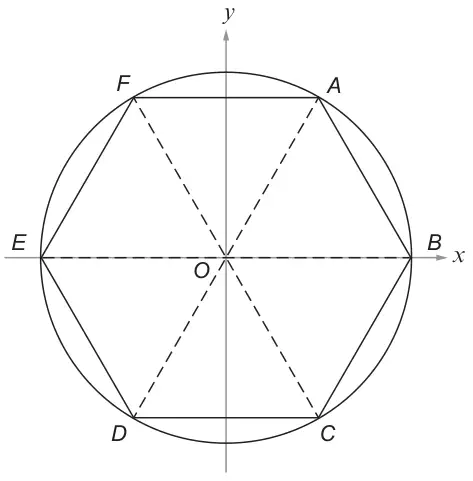
Diagram not drawn to scale
The diagram shows a sketch of a circle, centre O.
Points A, B, C, D, E and F lie on the circumference of the circle.
Triangles AOB, BOC, COD, DOE, EOF and FOA are congruent.
The circle has equation \(x^2 + y^2 = \dfrac{25}{4}\).
Calculate the perimeter of the hexagon ABCDEF.
You must justify any decisions that you make. [4]
| Scheme | Marks | Comments |
|---|---|---|
| \(\left(x^2 + y^2 = \dfrac{25}{4}\right)\ r^2 = \dfrac{25}{4}\) si | M1 | Allow for \(x^2 = \dfrac{25}{4}\) or \(x = \pm\dfrac{5}{2}\) but not for \(x + y = \dfrac{5}{2}\) |
| \(r = \dfrac{5}{2}\) (cm) si | A1 | |
| Justifies each congruent triangle being equilateral e.g. ‘The 6 triangles are congruent so the hexagon is regular and the 6 triangles are equilateral.’ or ‘The 6 triangles are congruent, so each angle at O is 60° and as they are all isosceles triangles (each side from O is a radius) then they must be equilateral.’ | E1 | Allow if e.g. OA and OB are indicated as being the same length on the diagram and the two base angles calculated as 60 after e.g. OAB or an exterior angle found as 360 ÷ 6 |
| \(\left(6\times\dfrac{5}{2} =\right) 15\) (cm) | B1 | FT ‘their derived \(\dfrac{5}{2}\)’ provided it is not \(\dfrac{25}{4}\) |
| (4) |