
Higher November 2024 Paper 2 Q18
18. The diagram shows a shape made from a cone and a hemisphere.
The cone has height 5 cm and base radius \((x + 1)\) cm.
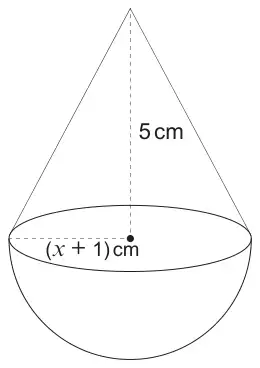
Diagram not drawn to scale
The volume of the shape is \(24\pi\) cm3.
(a) Show that \(2x^3 + 11x^2 + 16x = 65\). [5]
(b) A solution to the equation \(2x^3 + 11x^2 + 16x = 65\) lies between 1·6 and 1·7.
Use the method of trial and improvement to find the solution correct to two decimal places. [4]
Use the method of trial and improvement to find the solution correct to two decimal places. [4]
| Scheme | Marks | Comments |
|---|---|---|
| (Expression for total volume) \(\frac{1}{2} \times \frac{4}{3} \times \pi \times (x + 1)^3 + \frac{1}{3} \times \pi \times (x + 1)^2 \times 5\) | B1 | Need not be equated to \(24\pi\) for this mark |
| (Equate to \(24\pi\) and expands brackets correctly) \(2x^3 + 11x^2 + 16x + 7 = 72\) or \(\frac{2\pi}{3}x^3 + \frac{11}{3}\pi x^2 + \frac{16}{3}\pi x + \frac{7}{3}\pi = \frac{72}{3}\pi\ (= 24\pi)\) or \((2x^3 + 4x^2 + 2x + 2x^2 + 4x + 2) + (5x^2 + 10x + 5) = 72\) | B3 | FT provided of the form: \(k\pi(x + 1)^3 + 5m\pi(x + 1)^2\ (= 24\pi)\) B2 for volume equated to \(24\pi\) and both \((x + 1)^3\) and \((x + 1)^2\) expanded correctly e.g. \(\frac{2}{3}\pi(x^3 + 2x^2 + x + x^2 + 2x + 1) + \frac{5}{3}\pi(x^2 + 2x + 1) = 24\pi\) or \(2(x^3 + 2x^2 + x + x^2 + 2x + 1) + 5(x^2 + 2x + 1) = 72\) OR for \((x^2 + 2x + 1)(2x + 7) = 72\) B1 for one of the following:
|
| Convincingly leading to \(2x^3 + 11x^2 + 16x = 65\) | B1 | CAO If no marks award SC1 for sight of: \(\frac{1}{2} \times \frac{4}{3} \times \pi \times (x + 1)^3\) AND \(\frac{1}{3} \times \pi \times (x + 1)^2 \times 5\) If no marks or B1 B0 B0 awarded, award SC1 for the correct expansion of \((x + 1)^3\) \(x^3 + x^2 + x^2 + x^2 + x + x + x + 1\) or better |
| Scheme | Marks | Comments |
|---|---|---|
| One correct evaluation \(1.6 \leqslant x \leqslant 1.7\) | B1 | Correct evaluation regarded as enough to identify if < 0 or > 0. If evaluations not seen accept ‘too high’ or ‘too low’. |
| 2 correct evaluations \(1.635 \leqslant x \leqslant 1.655\), one \(\lt 0\), one \(\gt 0\). | B1 | |
| 2 correct evaluations \(1.645 \leqslant x \leqslant 1.655\), one \(\lt 0\), one \(\gt 0\). | M1 | |
| \(x = 1.65\) | A1 | Note: Evidence for M1 must be seen before A1 can be awarded. No marks awarded for an unsupported answer of 1.65. |
| (9) |
Notes
Some candidates may test \(2x^3 + 11x^2 + 16x - 65 = 0\)
| \(x\) | \(2x^3 + 11x^2 + 16x\) | ||
|---|---|---|---|
| 1.6 | 61.952 | ||
| 1.61 | 62.619… | ||
| 1.62 | 63.291… | ||
| 1.63 | 63.967… | ||
| 1.64 | 64.647… | 1.635 | 64.306… |
| 1.65 | 65.331… | 1.645 | 64.989… |
| 1.66 | 66.020… | 1.646 | 65.0575.. |
| 1.67 | 66.712… | 1.655 | 65.675… |
| 1.68 | 67.409… | ||
| 1.69 | 68.110… | ||
| 1.7 | 68.816… |