The exterior angle of a regular polygon is \(24^\circ\).
(i) How many sides does it have? [2]
(ii) Calculate the sum of all the interior angles of this polygon. [2]
(b)
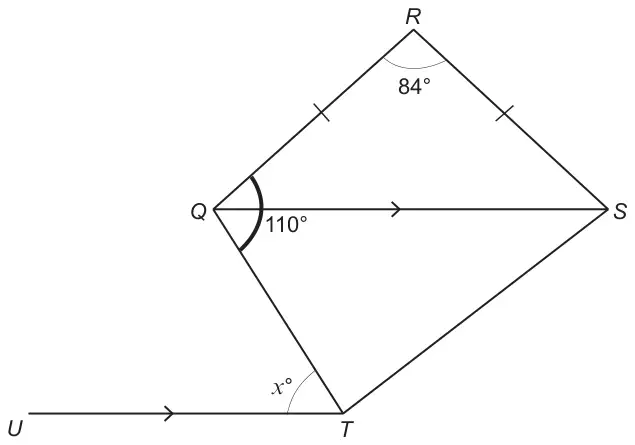
The diagram below shows a quadrilateral QRST. QS is parallel to UT. \(Q\hat{R}S = 84^\circ\), \(R\hat{Q}T = 110^\circ\) and QR = RS.
Diagram not drawn to scale
Calculate the value of \(x\). Give a reason for each step of your answer. [4]
Mark scheme (a)
Scheme
Marks
Comments
(i) 360 ÷ 24
M1
= 15 (sides)
A1
(ii) (180 – 24) × 15 oe
M1
FT ‘their number of sides’ if > 4
= 2340(°)
A1
FT
Alternative
Alternative Method for (ii)
Scheme
Marks
Comments
(15 – 2) × 180 oe
M1
FT ‘their number of sides’ if > 4
= 2340(°)
A1
FT
Mark scheme (b)
Scheme
Marks
Comments
Answers may be seen on the diagram
(RSQ or RQS =) 48 (°)
B2
B1 for (180 – 84) ÷ 2 oe
\(x = 62\)
B1
FT ‘their 48’ provided B1 previously awarded
At least two reasons given, including (SQT = QTU) alternate angles AND base angles in an isosceles triangle are equal.
E1
Dependent on at least B1 B1 previously awarded.
(8)
Alternative
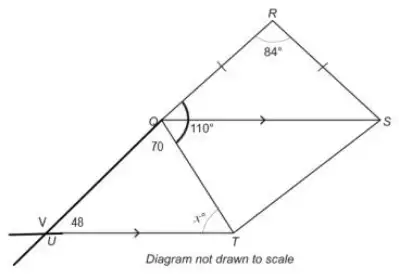
Alternative method (extending RQ and UT to meet at a point V)
Scheme
Marks
Comments
(RSQ or RQS =) 48 (°)
B2
B1 for (180 – 84) ÷ 2 oe
\(x = 62\)
B1
FT ‘their 48’ provided B1 previously awarded
At least two reasons given, including (RQS = QVT) corresponding angles or (SQV + QVT = 180) co-interior angles AND base angles in an isosceles triangle are equal.
We'd like to use Google Analytics cookies to count visits and see which pages help most. They're optional, and the site works exactly the same either way. Privacy policy