
4400 Higher November 2008 Paper 4 Q19
19 The diagram shows a trapezium \(ABCD\).
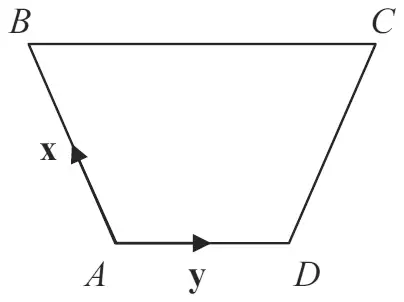
\(\overrightarrow{BC} = 2\overrightarrow{AD}\).
\(\overrightarrow{AB} = \mathbf{x}\). \(\overrightarrow{AD} = \mathbf{y}\).
(a) Find, in terms of \(\mathbf{x}\) and \(\mathbf{y}\),
(i) \(\overrightarrow{AC}\)
(ii) \(\overrightarrow{DC}\)
(2)(b) The point \(E\) is such that \(\overrightarrow{AE} = \mathbf{x} + \mathbf{y}\).
Use your answer to part (a)(ii) to explain why \(AECD\) is a parallelogram. (2)
Use your answer to part (a)(ii) to explain why \(AECD\) is a parallelogram. (2)
| Scheme | Marks |
|---|---|
| (i) Answer: \(\mathbf{x} + 2\mathbf{y}\) oe | B1 |
| (ii) Answer: \(\mathbf{x} + \mathbf{y}\) oe | B1 |
| (2) |
Notes
B1: eg \(-\mathbf{y} + \mathbf{x} + 2\mathbf{y}\) ISW
| Scheme | Marks |
|---|---|
| \(AE = DC\) or \(\overrightarrow{EC} = 2\mathbf{y} - \mathbf{y} = \mathbf{y}\) or \(\overrightarrow{EC} = \mathbf{y}\) shown on diag so \(\overrightarrow{EC} = \overrightarrow{AD}\) | B1 |
| \(AE\) // \(DC\) or \(EC\) & \(AD\) eq & // | B1 |
| (2) | |
| (4 marks) |
Notes
B1: dep (ii) correct
B1: if no mks otherwise scored, \(\overrightarrow{AE} = \overrightarrow{DC}\) B1