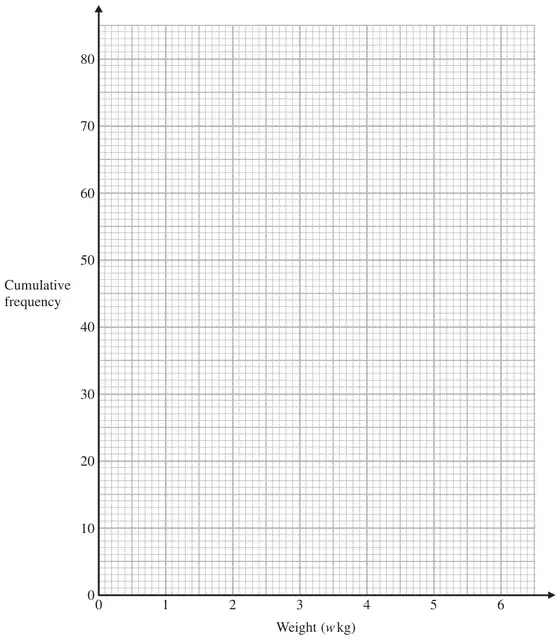
One day the company delivered 80 parcels. The table shows information about the weights, in kg, of these parcels.
Weight (\(w\) kg)
Frequency
\(0 \lt w \leqslant 1\)
19
\(1 \lt w \leqslant 2\)
17
\(2 \lt w \leqslant 3\)
15
\(3 \lt w \leqslant 4\)
12
\(4 \lt w \leqslant 5\)
10
\(5 \lt w \leqslant 6\)
7
(a) Complete the cumulative frequency table.
Weight (\(w\) kg)
Cumulative frequency
\(0 \lt w \leqslant 1\)
\(0 \lt w \leqslant 2\)
\(0 \lt w \leqslant 3\)
\(0 \lt w \leqslant 4\)
\(0 \lt w \leqslant 5\)
\(0 \lt w \leqslant 6\)
(1)
(b) On the grid, draw a cumulative frequency graph for your table.(2)
Sue says,
“75% of the parcels weigh less than 3.4 kg.”
*(c) Is Sue correct? You must show how you get your answer. (3)
Mark scheme (a)
Answer
Mark
Notes
19, 36, 51, 63, 73, 80
1
B1 cao
Mark scheme (b)
Answer
Mark
Notes
cf graph
2
M1 for at least 5 of the 6 points plotted at each upper end of the interval (not joined) or 5 of the 6 points plotted consistently within interval (not upper end) and joined (dep on a cf table with no more than one arithmetic error) A1 correct graph
Mark scheme (c)
Answer
Mark
Notes
comparable value and conclusion
3
M1 for indication of a reading taken from a cf graph using weight = 3.4 kg or find UQ from 60 A1 for value given between 55 & 57 or 3.6 & 3.8 C1 (dep on at least M1) for conclusion (justified)