
D2 June 2008 Q5
5.
(a) In game theory, explain the circumstances under which column (\(x\)) dominates column (\(y\)) in a two-person zero-sum game. (2)
Liz and Mark play a zero-sum game. This game is represented by the following pay-off matrix for Liz.
| Mark plays 1 | Mark plays 2 | Mark plays 3 | |
|---|---|---|---|
| Liz plays 1 | 5 | 3 | 2 |
| Liz plays 2 | 4 | 5 | 6 |
| Liz plays 3 | 6 | 4 | 3 |
(b) Verify that there is no stable solution to this game. (3)
(c) Find the best strategy for Liz and the value of the game to her. (9)
The game now changes so that when Liz plays 1 and Mark plays 3 the pay-off to Liz changes from 2 to 4. All other pay-offs for this zero-sum game remain the same.
(d) Explain why a graphical approach is no longer possible and briefly describe the method Liz should use to determine her best strategy. (2)
| Scheme | Marks |
|---|---|
| For each row the element in column x must be less than the element in column y. | B2, 1, 0 |
| (2) |
| Scheme | Marks |
|---|---|
| Row minimum \(\{2, 4, 3\}\) row maximin \(= 4\) | M1 |
| Column maximum \(\{6, 5, 6\}\) column minimax \(= 5\) | A1 |
| \(4 \neq 5\) so not stable | A1 |
| (3) |
| Scheme | Marks | ||||||||||||
|---|---|---|---|---|---|---|---|---|---|---|---|---|---|
Row 3 dominates row 1, so matrix reduces to
| B1 | ||||||||||||
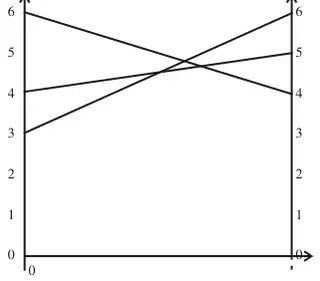
| Let Liz play 2 with probability \(p\) and 3 with probability \((1 - p)\) If Mark plays 1: Liz’s gain is \(4p + 6(1 - p) = 6 - 2p\) If Mark plays 2: Liz’s gain is \(5p + 4(1 - p) = 4 + p\) If Mark plays 3: Liz’s gain is \(6p + 3(1 - p) = 3 + 3p\) | M1 A1 (3) | ||||||||||||
 | B2, 1, 0 (2) | ||||||||||||
| \(4 + p = 6 - 2p\) | M1 A1 | ||||||||||||
| \(p = \dfrac{2}{3}\) | A1ft A1 (4) | ||||||||||||
| (9) |
| Scheme | Marks |
|---|---|
| Liz should play row 1 – never, row 2 – \(\dfrac{2}{3}\) of the time, row 3 – \(\dfrac{1}{3}\) of the time and the value of the game is \(4\dfrac{2}{3}\) to her. | B1 |
| Row 3 no longer dominates row 1 and so row 1 can not be deleted. Use Simplex (linear programming). | B1 |
| (2) | |
| (16 marks) |
Notes
The scheme prints the (d) label against the statement of Liz’s strategy and value, which answers part (c); the two B1 marks shown are as printed.