
D2 June 2009 Q3
3. A two-person zero-sum game is represented by the following pay-off matrix for player A.
| B plays 1 | B plays 2 | B plays 3 | |
|---|---|---|---|
| A plays 1 | −5 | 6 | −3 |
| A plays 2 | 1 | −4 | 13 |
| A plays 3 | −2 | 3 | −1 |
(a) Verify that there is no stable solution to this game. (3)
(b) Reduce the game so that player B has a choice of only two actions. (1)
(c) Write down the reduced pay-off matrix for player B. (2)
(d) Find the best strategy for player B and the value of the game to player B. (7)
| Scheme | Marks |
|---|---|
| Row minima {−5, −4, −2} row maximin = −2 Column maxima {1, 6, 13} col minimax = 1 \(-2 \ne 1\) therefore not stable. | M1 A1 A1 |
| (3) |
| Scheme | Marks |
|---|---|
| Column 1 dominates column 3, so column 3 can be deleted. | B1 |
| (1) |
| Scheme | Marks | ||||||||||||
|---|---|---|---|---|---|---|---|---|---|---|---|---|---|
| B1 B1 | ||||||||||||
| (2) |
| Scheme | Marks |
|---|---|
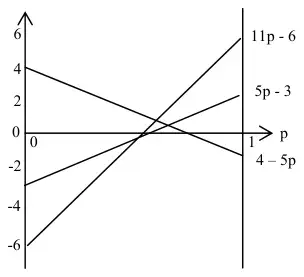
| Let B play row 1 with probability \(p\) and row 2 with probability \((1-p)\) If A plays 1, B’s expected winnings are \(11p - 6\) If A plays 2, B’s expected winnings are \(4 - 5p\) If A plays 3, B’s expected winnings are \(5p - 3\) | M1 A1 |
 | M1 A1 |
| \(5p - 3 = 4 - 5p\) \(10p = 7\) \(p = \dfrac{7}{10}\) | M1 |
| B should play 1 with a probability of 0.7 2 with a probability of 0.3 and never play 3 | A1 |
| The value of the game is 0.5 to B | A1 |
| (7) | |
| (13 marks) |