
FP3 June 2018 Q2
2.
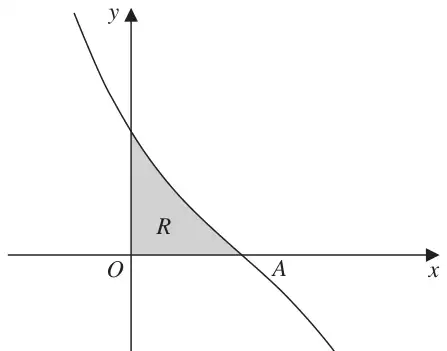
Figure 1 shows a sketch of part of the curve with equation \[y = 5\cosh x - 6\sinh x\]
The curve crosses the \(x\)-axis at the point \(A\).
The finite region \(R\), bounded by the curve and the coordinate axes, is shown shaded in Figure 1.
The region \(R\) is rotated through \(2\pi\) radians about the \(x\)-axis.
| Scheme | Marks |
|---|---|
| \(y = 5\cosh x - 6\sinh x\) | |
| \(5\cosh x - 6\sinh x = 0 \Rightarrow 5\left(\dfrac{e^x + e^{-x}}{2}\right) - 6\left(\dfrac{e^x - e^{-x}}{2}\right) = 0\) Substitutes the correct exponential forms but allow the “2’s” to be missing | M1 |
| \(e^{2x} = 11\) | A1 |
| \(x = \ln\sqrt{11}\) | A1 |
| (3) |
Notes
A1: Correct equation
A1: Correct value (oe e.g. \(\dfrac{1}{2}\ln 11\))
Alternative 1
| Scheme | Marks |
|---|---|
| \(5\cosh x - 6\sinh x = 0 \Rightarrow \tanh x = \dfrac{5}{6}\) | M1 |
| \(x = \text{artanh}\left(\dfrac{5}{6}\right)\) | A1 |
| \(x = \ln\sqrt{11}\) | A1 |
M1: Rearranges to \(\tanh x = \ldots\)
A1: Correct equation
A1: Correct value (oe e.g. \(\dfrac{1}{2}\ln 11\))
Alternative 2
| Scheme | Marks |
|---|---|
| \(5\cosh x - 6\sinh x = 0 \Rightarrow 25\cosh^2 x = 36\sinh^2 x\) \(25\left(1 + \sinh^2 x\right) = 36\sinh^2 x\) or \(25\cosh^2 x = 36\left(\cosh^2 x - 1\right)\) \(\sinh^2 x = \dfrac{25}{11}\) or \(\cosh^2 x = \dfrac{36}{11}\) Rearranges to \(\sinh^2 x = \ldots\) or \(\cosh^2 x = \ldots\) | M1 |
| \(\Rightarrow \sinh x = (\pm)\dfrac{5}{\sqrt{11}}\) or \(\Rightarrow \cosh x = (\pm)\dfrac{6}{\sqrt{11}}\) | A1 |
| \(x = \ln\sqrt{11}\) | A1 |
A1: Correct equation (Allow \(\pm\))
A1: Correct value (oe e.g. \(\dfrac{1}{2}\ln 11\))
Note that this is not a proof so allow “h’s” to be lost along the way as long as the intention is clear.
| Scheme | Marks |
|---|---|
| \((5\cosh x - 6\sinh x)^2 \equiv 25\cosh^2 x - 60\cosh x\sinh x + 36\sinh^2 x\) \(\equiv 25\left(\dfrac{\cosh 2x + 1}{2}\right) - 60\dfrac{1}{2}\sinh 2x + 36\left(\dfrac{\cosh 2x - 1}{2}\right)\) Squares to obtain \(p\cosh^2 x + q\cosh x\sinh x + r\sinh^2 x,\ \ p, q, r \neq 0\) and attempts to use at least one correct “double angle” hyperbolic identity for cosh2\(x\) or sinh2\(x\) e.g. \(\cosh 2x = \cosh^2 x + \sinh^2 x = 2\cosh^2 x - 1 = 2\sinh^2 x + 1,\ \sinh 2x = 2\sinh x\cosh x\) | M1 |
| \(= \dfrac{61}{2}\cosh 2x - 30\sinh 2x - \dfrac{11}{2}\) | A1 A1 |
| (3) |
Notes
A1: Two correct terms in their final expression
A1: All correct terms in their final expression
Alternative 1 for (b) using exponentials after squaring
| Scheme | Marks |
|---|---|
| \((5\cosh x - 6\sinh x)^2 \equiv 25\cosh^2 x - 60\cosh x\sinh x + 36\sinh^2 x\) \(= 25\left(\dfrac{e^x + e^{-x}}{2}\right)^2 - 60\left(\dfrac{e^x + e^{-x}}{2}\right)\left(\dfrac{e^x - e^{-x}}{2}\right) + 36\left(\dfrac{e^x - e^{-x}}{2}\right)^2\) \(= \left(\dfrac{25}{2} + \dfrac{36}{2}\right)\left(\dfrac{e^{2x} + e^{-2x}}{2}\right) - 30\left(\dfrac{e^{2x} - e^{-2x}}{2}\right) + \dfrac{50}{4} - \dfrac{72}{4}\) \(= (\ldots)(\cosh 2x) + (\ldots)(\sinh 2x) + (\ldots)\) Squares to obtain \(p\cosh^2 x + q\cosh x\sinh x + r\sinh^2 x,\ \ p, q, r \neq 0\) and attempts to use at least one correct exponential definition for cosh2\(x\) or sinh2\(x\) | M1 |
| \(= \dfrac{61}{2}\cosh 2x - 30\sinh 2x - \dfrac{11}{2}\) | A1 A1 |
| (3) |
A1: Two correct terms in their final expression
A1: All correct terms in their final expression
Alternative 2 for (b) using exponentials before squaring
| Scheme | Marks |
|---|---|
| \((5\cosh x - 6\sinh x)^2 = \left(5\left(\dfrac{e^x + e^{-x}}{2}\right) - 6\left(\dfrac{e^x - e^{-x}}{2}\right)\right)^2 = \left(\dfrac{11}{2}e^{-x} - \dfrac{1}{2}e^x\right)^2\) \(= \left(\dfrac{121}{4}e^{-2x} + \dfrac{1}{4}e^{2x} - \dfrac{11}{2}\right)\) \(= (\ldots)(\cosh 2x) + (\ldots)(\sinh 2x) + (\ldots)\) Substitutes the correct exponential forms and squares to obtain \(pe^{-2x} + qe^{2x} + r,\ \ p, q, r \neq 0\) and attempts to use at least one correct exponential definition for cosh2\(x\) or sinh2\(x\) | M1 |
| \(= \dfrac{61}{2}\cosh 2x - 30\sinh 2x - \dfrac{11}{2}\) | A1 A1 |
| (3) |
A1: Two correct terms in their final expression
A1: All correct terms in their final expression
| Scheme | Marks |
|---|---|
| Note that \(\pi\) is not needed for the first 3 marks of (c) | |
| \(\displaystyle V = (\pi)\int\left(\frac{61}{2}\cosh 2x - 30\sinh 2x - \frac{11}{2}\right)\mathrm{d}x\) | M1 |
| \((\pi)\left[\dfrac{61}{4}\sinh 2x - 15\cosh 2x - \dfrac{11}{2}x\right]\) | A1ft |
| \((\pi)\left[\dfrac{61}{4}\sinh(\ln 11) - 15\cosh(\ln 11) - \dfrac{11}{4}(\ln 11) - (-15)\right]\) Note that \(\cosh(\ln 11) = \dfrac{61}{11},\ \sinh(\ln 11) = \dfrac{60}{11}\) Correct use of limits. Must see 0 and their value from (a) substituted into all 3 terms (although the “0’s” can be implied) and subtracted the right way round. Dependent on the first method mark. | dM1 |
| \(= \left(15 - \dfrac{11}{4}\ln 11\right)\pi\) or e.g. \(\left(15 - \dfrac{11}{2}\ln\sqrt{11}\right)\pi\) Or e.g. \(\dfrac{30\pi}{2} - \dfrac{11\pi}{4}\ln 11,\quad 15\pi - \dfrac{11\pi}{2}\ln\sqrt{11}\) | A1 |
| (4) | |
| (10 marks) |
Notes
M1: Uses \(V = (\pi)\int y^2\,\mathrm{d}x\) with their \(y^2\) where \(y^2\) is of the form \(= a\cosh 2x + b\sinh 2x + c\)
A1ft: Correct integration, ft their \(a\), \(b\) and \(c\) or the letters \(a\), \(b\) and \(c\) or a combination of both or “made up” values.
A1: Correct exact answer in any equivalent exact form.
Alternative to (c) using exponentials
| Scheme | Marks |
|---|---|
| \(\displaystyle V = \frac{(\pi)}{4}\int\left(121e^{-2x} - 22 + e^{2x}\right)\mathrm{d}x\) | M1 |
| \(\dfrac{(\pi)}{4}\left[\dfrac{e^{2x}}{2} - \dfrac{121e^{-2x}}{2} - 22x\right]\) | A1ft |
| \(\dfrac{(\pi)}{4}\left[\dfrac{11}{2} - \dfrac{11}{2} - 11\ln 11 - \dfrac{1}{2} + \dfrac{121}{2}\right]\) | dM1 |
| \(= \left(15 - \dfrac{11}{4}\ln 11\right)\pi\) or e.g. \(\left(15 - \dfrac{11}{2}\ln\sqrt{11}\right)\pi\) Or e.g. \(\dfrac{30\pi}{2} - \dfrac{11\pi}{4}\ln 11,\quad 15\pi - \dfrac{11\pi}{2}\ln\sqrt{11}\) | A1 |
| (4) |
M1: Uses \(V = (\pi)\int y^2\,\mathrm{d}x\)
A1ft: Correct integration. You can follow through their expansion from part (a).
dM1: Correct use of limits (0 and their value from (a)). Dependent on the first method mark.
A1: Correct exact answer in any equivalent exact form.