
FP3 June 2013 (R) Q3
3. The point \(P\) lies on the ellipse \(E\) with equation \[\frac{x^2}{36} + \frac{y^2}{9} = 1\]
\(N\) is the foot of the perpendicular from point \(P\) to the line \(x = 8\)
\(M\) is the midpoint of \(PN\).
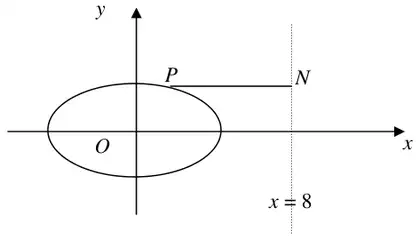
(a) Sketch the graph of the ellipse \(E\), showing also the line \(x = 8\) and a possible position for the line \(PN\). (1)
(b) Find an equation of the locus of \(M\) as \(P\) moves around the ellipse. (4)
(c) Show that this locus is a circle and state its centre and radius. (3)
| Scheme | Marks |
|---|---|
| A closed curve approximately symmetrical about both axes. A vertical line to the right of the curve. A horizontal line from any point on the ellipse to the vertical line with both P and N clearly marked. | B1 |
| (1) |
| Scheme | Marks |
|---|---|
| \(M\) is \(\left(\dfrac{x + 8}{2}, y\right) = (X, Y)\) or \(\left(\dfrac{6\cos\theta + 8}{2}, 3\sin\theta\right) = (X, Y)\) M1: Finds the mid-point of PN A1: Correct mid-point | M1A1 |
| \(\dfrac{(2X - 8)^2}{36} + \dfrac{Y^2}{9} = 1\) M1: Attempt cartesian equation A1: Correct equation | M1 A1 |
| (4) |
Notes
Special Case: In (b) they assume the locus is a circle and find the intercepts on the \(x\)-axis as (1, 0) and (7, 0) and hence deduce the centre (4, 0) and radius 3. This approach scores no marks in (b) but allow recovery in (c).
| Scheme | Marks |
|---|---|
| The next 3 marks are dependent on having the equation of a circle. | |
| Circle because equation may be written \((x - 4)^2 + y^2 = 3^2\) Convincing argument – allow follow through provided they do have a circle! Can be implied by their centre and radius. | B1ft |
| The centre is \((4, 0)\) and the radius is 3 M1: Use their circle equation to find centre and radius A1: Correct centre and radius | M1A1 |
| (3) | |
| (8 marks) |