
FP2 June 2008 Q8
8.
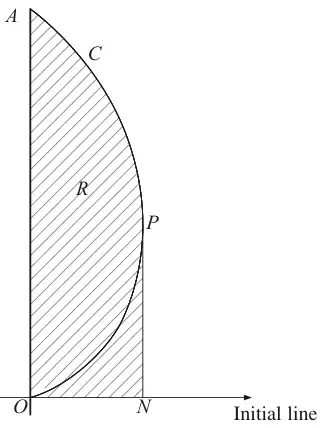
The curve \(C\) shown in the diagram above has polar equation \[r = 4(1 - \cos\theta), \quad 0 \leqslant \theta \leqslant \frac{\pi}{2}.\]
At the point \(P\) on \(C\), the tangent to \(C\) is parallel to the line \(\theta = \dfrac{\pi}{2}\).
The curve \(C\) meets the line \(\theta = \dfrac{\pi}{2}\) at the point \(A\). The tangent to \(C\) at \(P\) meets the initial line at the point \(N\). The finite region \(R\), shown shaded in the diagram above, is bounded by the initial line, the line \(\theta = \dfrac{\pi}{2}\), the arc \(AP\) of \(C\) and the line \(PN\).
| Scheme | Marks |
|---|---|
| \(r\cos\theta = 4(\cos\theta - \cos^2\theta)\) or \(r\cos\theta = 4\cos\theta - 2\cos 2\theta - 2\) | B1 |
| \(\dfrac{\mathrm{d}(r\cos\theta)}{\mathrm{d}\theta} = 4(-\sin\theta + 2\cos\theta\sin\theta)\) or \(\dfrac{\mathrm{d}(r\cos\theta)}{\mathrm{d}\theta} = 4(-\sin\theta + \sin 2\theta)\) | M1A1 |
| \(4(-\sin\theta + 2\cos\theta\sin\theta) = 0 \Rightarrow \cos\theta = \dfrac{1}{2}\) which is satisfied by \(\theta = \dfrac{\pi}{3}\) and \(r = 2\) (*) | dM1A1 |
| (5) |
Alternative for first 3 marks
| Scheme | Marks |
|---|---|
| \(\dfrac{\mathrm{d}r}{\mathrm{d}\theta} = 4\sin\theta\) | B1 |
| \(\dfrac{\mathrm{d}x}{\mathrm{d}\theta} = -r\sin\theta + \cos\theta\dfrac{\mathrm{d}r}{\mathrm{d}\theta} = -4\sin\theta + 8\sin\theta\cos\theta\) | M1A1 |
Substituting \(r = 2\) and \(\theta = \dfrac{\pi}{3}\) into original equation scores 0 marks. (corrected from the printed mark scheme: “0 = f”, a lost symbol)
| Scheme | Marks |
|---|---|
| \(\dfrac{1}{2}\displaystyle\int r^2\,\mathrm{d}\theta = (8)\int (1 - 2\cos\theta + \cos^2\theta)\,\mathrm{d}\theta\) | M1 |
| \(= (8)\left[\theta - 2\sin\theta + \dfrac{\sin 2\theta}{4} + \dfrac{\theta}{2}\right]\) | M1A1 |
| \(8\left[\dfrac{3\theta}{2} - 2\sin\theta + \dfrac{\sin 2\theta}{4}\right]_{\pi/3}^{\pi/2} = 8\left(\left(\dfrac{3\pi}{4} - 2\right) - \left(\dfrac{\pi}{2} - \sqrt{3} + \dfrac{\sqrt{3}}{8}\right)\right) = 2\pi - 16 + 7\sqrt{3}\) | M1 |
| Triangle: \(\dfrac{1}{2}(r\cos\theta)(r\sin\theta) = \dfrac{1}{2} \times 1 \times \sqrt{3} = \dfrac{\sqrt{3}}{2}\) | M1A1 |
| Total area: \(\left(2\pi - 16 + 7\sqrt{3}\right) + \dfrac{\sqrt{3}}{2} = (2\pi - 16) + \dfrac{15\sqrt{3}}{2}\) | (A1)A1 |
| (8) | |
| (13 marks) |
Notes
M1 needs attempt to expand \((1 - \cos\theta)^2\) giving three terms (allow slips)
Second M1 needs integration of \(\cos^2\theta\) using \(\cos 2\theta \pm 1\)
Third M1 needs correct limits – may evaluate two areas and subtract
M1 needs attempt at area of triangle and A1 for cao
Next A1 is for value of area within curve, then final A1 is cao, must be exact but allow 4 terms and isw for incorrect collection of terms
Special case for use of \(r\sin\theta\) gives B0M1A0M0A0