
FP2 January 2006 Q4
4. A curve \(C\) has polar equation \(r^2 = a^2\cos 2\theta,\ 0 \leqslant \theta \leqslant \dfrac{\pi}{4}\).
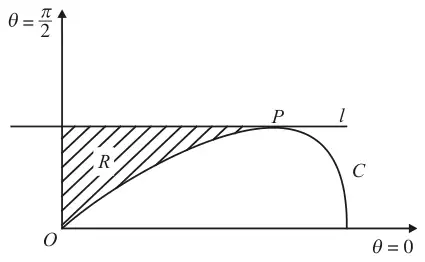
The line \(l\) is parallel to the initial line, and \(l\) is the tangent to \(C\) at the point \(P\), as shown in the figure above.
The shaded region \(R\), shown in the figure above, is bounded by \(C\), the line \(l\) and the half-line with equation \(\theta = \dfrac{\pi}{2}\).
| Scheme | Marks |
|---|---|
| (i) \(r^2\sin^2\theta = a^2\cos 2\theta\sin^2\theta = a^2(1 - 2\sin^2\theta)\sin^2\theta\) \((= a^2(\sin^2\theta - 2\sin^4\theta))\) | B1 |
| (ii) \(\dfrac{\mathrm{d}}{\mathrm{d}\theta}(a^2(\sin^2\theta - 2\sin^4\theta)) = a^2(2\sin\theta\cos\theta - 8\sin^3\theta\cos\theta),\ \ = 0\) | M1, A1, M1 |
| \(2 = 8\sin^2\theta\) (Proceed to a \(\sin^2\theta = b\)) | M1 |
| \(\sin\theta = \dfrac{1}{2} \quad \Rightarrow \quad \theta = \dfrac{\pi}{6},\ \ r = \dfrac{a}{\sqrt{2}}\) | A1, A1 cso |
| (7) |
Notes
(a)(ii) First A1: Correct derivative of a correct expression for \(r^2\sin^2\theta\) or \(r\sin\theta\).
(corrected from the printed mark scheme: the derivative is printed as \(a^2(2\sin\theta\cos\theta - 8\sin^2\theta\cos\theta)\); the derivative of \(2\sin^4\theta\) is \(8\sin^3\theta\cos\theta\))
| Scheme | Marks |
|---|---|
| \(\dfrac{a^2}{2}\displaystyle\int\cos 2\theta\,\mathrm{d}\theta = \dfrac{a^2}{4}\sin 2\theta\) M: Attempt \(\dfrac{1}{2}\displaystyle\int r^2\,\mathrm{d}\theta\), to get \(k\sin 2\theta\) | M1 A1 |
| \([\ldots]_{\pi/6}^{\pi/4} = \dfrac{a^2}{4}\left[1 - \dfrac{\sqrt{3}}{2}\right]\) M: Using correct limits | M1 A1 |
| \(\Delta = \dfrac{1}{2}\left(\dfrac{a}{\sqrt{2}} \cdot \dfrac{1}{2}\right) \times \left(\dfrac{a}{\sqrt{2}} \cdot \dfrac{\sqrt{3}}{2}\right) = \dfrac{\sqrt{3}a^2}{16}\) M: Full method for rectangle or triangle | M1 A1 |
| \(R = \dfrac{\sqrt{3}a^2}{16} - \dfrac{a^2}{4}\left[1 - \dfrac{\sqrt{3}}{2}\right] = \dfrac{a^2}{16}(3\sqrt{3} - 4)\) M: Subtracting, either way round | dM1 A1 cso |
| (8) | |
| (15 marks) |
Notes
Final M mark is dependent on the first and third M’s.
Attempts at the triangle area by integration: a full method is required for M1.
Missing \(a\) factors: (or \(a^2\)) Maximum one mark penalty in the question.(corrected from the printed mark scheme: the second bracket of the triangle area is printed as \(\left(\dfrac{a}{\sqrt{2}} - \dfrac{\sqrt{3}}{2}\right)\); it is the product \(\dfrac{a}{\sqrt{2}} \cdot \dfrac{\sqrt{3}}{2}\), as the answer \(\dfrac{\sqrt{3}a^2}{16}\) shows)