
FP1 January 2013 Q5
5. \[\mathrm{f}(x) = (4x^2 + 9)(x^2 - 6x + 34)\]
(a) Find the four roots of \(\mathrm{f}(x) = 0\)
Give your answers in the form \(x = p + \mathrm{i}q\), where \(p\) and \(q\) are real. (5)
Give your answers in the form \(x = p + \mathrm{i}q\), where \(p\) and \(q\) are real. (5)
(b) Show these four roots on a single Argand diagram. (2)
| Scheme | Marks |
|---|---|
| \(4x^2 + 9 = 0 \Rightarrow x = k\mathrm{i},\quad x = \pm\dfrac{3}{2}\mathrm{i}\) or equivalent | M1, A1 |
| Solving 3-term quadratic by formula or completion of the square \(x = \dfrac{6 \pm \sqrt{36 - 136}}{2}\) or \((x - 3)^2 - 9 + 34 = 0\) | M1 |
| \(= 3 + 5\mathrm{i}\) and \(3 - 5\mathrm{i}\) | A1 A1ft |
| (5) |
Notes
(a) Final A follow through conjugate of their first root.
| Scheme | Marks |
|---|---|
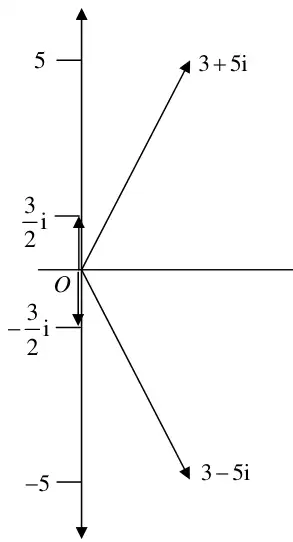 | |
| Two roots on imaginary axis | B1ft |
| Two roots – one the conjugate of the other | B1ft |
| Accept points or vectors | |
| (2) | |
| [7] |
Notes
(b) First B award only for first pair imaginary,
Second B award only if second pair complex.
Complex numbers labelled , scales or coordinates or vectors required for B marks.