
FP1 January 2012 Q5
5. The roots of the equation \[z^3 - 8z^2 + 22z - 20 = 0\] are \(z_1\), \(z_2\) and \(z_3\).
(a) Given that \(z_1 = 3 + \mathrm{i}\), find \(z_2\) and \(z_3\). (4)
(b) Show, on a single Argand diagram, the points representing \(z_1\), \(z_2\) and \(z_3\). (2)
| Scheme | Marks |
|---|---|
| \((z_2) = 3 - \mathrm{i}\) | B1 |
| \((z - (3 + \mathrm{i}))(z - (3 - \mathrm{i})) = z^2 - 6z + 10\) Attempt to expand \((z - (3 + \mathrm{i}))(z - (3 - \mathrm{i}))\) or any valid method to establish the quadratic factor e.g. \(z = 3 \pm \mathrm{i} \Rightarrow z - 3 = \pm\mathrm{i} \Rightarrow z^2 - 6z + 9 = -1\) \(z = 3 \pm \sqrt{-1} = \dfrac{6 \pm \sqrt{-4}}{2} \Rightarrow b = -6, c = 10\) Sum of roots 6, product of roots 10 \(\therefore z^2 - 6z + 10\) | M1 |
| \((z^2 - 6z + 10)(z - 2) = 0\) Attempt at linear factor with their \(cd\) in \((z^2 + az + c)(z + d) = \pm 20\) Or \((z^2 - 6z + 10)(z + a) \Rightarrow 10a = -20\) Or attempts f(2) | M1 |
| \((z_3) = 2\) | A1 |
| (4) |
Notes
Showing that \(f(2) = 0\) is equivalent to scoring both M’s so it is possible to gain all 4 marks quite easily e.g. \(z_2 = 3 - \mathrm{i}\) B1, shows \(f(2) = 0\) M2, \(z_3 = 2\) A1.
Answers only can score 4/4
| Scheme | Marks |
|---|---|
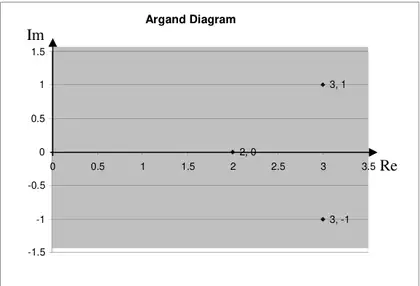 | B1 B1 |
| (2) | |
| (6 marks) |
Notes
First B1 for plotting \((3,\ 1)\) and \((3,\ -1)\) correctly with an indication of scale or labelled with coordinates (allow points/lines/crosses/vectors etc.) Allow \(\mathrm{i}/{-\mathrm{i}}\) for \(1/{-1}\) marked on imaginary axis.
Second B1 for plotting \((2,\ 0)\) correctly relative to the conjugate pair with an indication of scale or labelled with coordinates or just 2