
FP1 June 2013 (R) Q4
4. \[\mathrm{f}(x) = (4x^2 + 9)(x^2 - 2x + 5)\]
(a) Find the four roots of \(\mathrm{f}(x) = 0\) (4)
(b) Show the four roots of \(\mathrm{f}(x) = 0\) on a single Argand diagram. (2)
| Scheme | Marks |
|---|---|
| \(\mathrm{f}(x) = (4x^2 + 9)(x^2 - 2x + 5) = 0\) | |
| \((4x^2 + 9) = 0 \Rightarrow x = \dfrac{3\mathrm{i}}{2}, -\dfrac{3\mathrm{i}}{2}\) An attempt to solve \((4x^2 + 9) = 0\) which involves i. \(\dfrac{3\mathrm{i}}{2}, -\dfrac{3\mathrm{i}}{2}\) | M1 A1 |
| \((x^2 - 2x + 5) = 0 \Rightarrow x = \dfrac{2 \pm \sqrt{4 - 4(1)(5)}}{2(1)}\) Solves the 3TQ | M1 |
| \(\Rightarrow x = \dfrac{2 \pm \sqrt{-16}}{2}\) | |
| \(\Rightarrow x = 1 \pm 2\mathrm{i}\) \(1 \pm 2\mathrm{i}\) | A1 |
| (4) |
Notes
Method mark for solving 3 term quadratic:
1. Factorisation
\((x^2 + bx + c) = (x + p)(x + q)\), where \(|pq| = |c|\), leading to \(x =\)
\((ax^2 + bx + c) = (mx + p)(nx + q)\), where \(|pq| = |c|\) and \(|mn| = |a|\), leading to \(x =\)
2. Formula
Attempt to use correct formula (with values for \(a\), \(b\) and \(c\)).
3. Completing the square
Solving \(x^2 + bx + c = 0\): \(\left(x \pm \dfrac{b}{2}\right)^2 \pm q \pm c, \quad q \neq 0\), leading to \(x = \ldots\)
| Scheme | Marks |
|---|---|
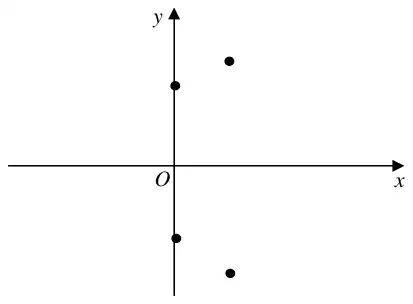 Any two of their roots plotted correctly on a single diagram, which have been found in part (a). Both sets of their roots plotted correctly on a single diagram with symmetry about \(y = 0\). | B1ft B1ft |
| (2) | |
| (6 marks) |