
FP1 January 2010 Q6
6. Given that 2 and \(5 + 2\mathrm{i}\) are roots of the equation \[x^3 - 12x^2 + cx + d = 0, \qquad c,\ d \in \mathbb{R},\]
(a) write down the other complex root of the equation. (1)
(b) Find the value of \(c\) and the value of \(d\). (5)
(c) Show the three roots of this equation on a single Argand diagram. (2)
| Scheme | Marks |
|---|---|
| \(5 - 2\mathrm{i}\) is a root | B1 |
| (1) |
| Scheme | Marks |
|---|---|
| \(\big(x - (5 + 2\mathrm{i})\big)\big(x - (5 - 2\mathrm{i})\big) = x^2 - 10x + 29\) | M1 M1 |
| \(x^3 - 12x^2 + cx + d = (x^2 - 10x + 29)(x - 2)\) | M1 |
| \(c = 49, \qquad d = -58\) | A1, A1 |
| (5) |
Notes
(b) 1st M: Form brackets using \((x - \alpha)(x - \beta)\) and expand.
2nd M: Achieve a 3-term quadratic with no i's.
(b) Alternative
| Scheme | Marks |
|---|---|
| Substitute a complex root (usually 5+2i) and expand brackets | M1 |
| \((5 + 2\mathrm{i})^3 - 12(5 + 2\mathrm{i})^2 + c(5 + 2\mathrm{i}) + d = 0\) | |
| \((125 + 150\mathrm{i} - 60 - 8\mathrm{i}) - 12(25 + 20\mathrm{i} - 4) + (5c + 2c\mathrm{i}) + d = 0\) (2nd M for achieving an expression with no powers of i) | M1 |
| Equate real and imaginary parts | M1 |
| \(c = 49, \qquad d = -58\) | A1, A1 |
| Scheme | Marks |
|---|---|
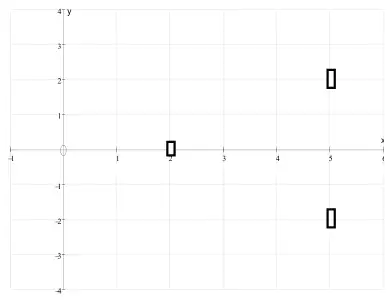 | B1 |
| Fully correct, labelled | B1 |
| (2) | |
| [8] |