
FP1 June 2009 Q1
1. The complex numbers \(z_1\) and \(z_2\) are given by \[z_1 = 2 - \mathrm{i} \quad \text{and} \quad z_2 = -8 + 9\mathrm{i}\]
Find, showing your working,
| Scheme | Marks |
|---|---|
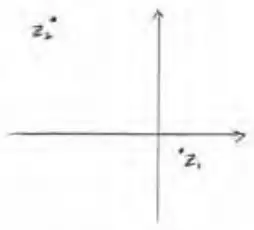 | B1 |
| (1) |
Notes
(a) B1 needs both complex numbers as either points or vectors, in correct quadrants and with ‘reasonably correct’ relative scale
| Scheme | Marks |
|---|---|
| \(|z_1| = \sqrt{2^2 + (-1)^2} = \sqrt{5}\) (or awrt 2.24) | M1 A1 |
| (2) |
Notes
(b) M1 Attempt at Pythagoras to find modulus of either complex number
A1 condone correct answer even if negative sign not seen in (−1) term
A0 for \(\pm\sqrt{5}\)
| Scheme | Marks |
|---|---|
| \(\alpha = \arctan\left(\dfrac{1}{2}\right)\) or \(\arctan\left(-\dfrac{1}{2}\right)\) | M1 |
| \(\arg z_1 = -0.46\) or 5.82 (awrt) (answer in degrees is A0 unless followed by correct conversion) | A1 |
| (2) |
Notes
(c) \(\arctan 2\) is M0 unless followed by \(\boxed{\tfrac{3\pi}{2} + \arctan 2}\) or \(\boxed{\tfrac{\pi}{2} - \arctan 2}\) Need to be clear that \(\arg z = -0.46\) or 5.82 for A1
| Scheme | Marks |
|---|---|
| \(\dfrac{-8 + 9\mathrm{i}}{2 - \mathrm{i}} \times \dfrac{2 + \mathrm{i}}{2 + \mathrm{i}}\) | M1 |
| \(= \dfrac{-16 - 8\mathrm{i} + 18\mathrm{i} - 9}{5} = -5 + 2\mathrm{i}\) i.e. \(a = -5\) and \(b = 2\) or \(-\tfrac{2}{5}a\) | A1 A1ft |
| (3) | |
| [8] |
Alternative method to part (d)
| Scheme | Marks |
|---|---|
| \(-8 + 9\mathrm{i} = (2 - i)(a + bi)\), and so \(2a + b = -8\) and \(2b - a = 9\) and attempt to solve as far as equation in one variable | M1 |
| So \(a = -5\) and \(b = 2\) | A1 A1cao |
Notes
(d) M1 Multiply numerator and denominator by conjugate of their denominator
A1 for −5 and A1 for 2i (should be simplified)
Alternative scheme for (d) Allow slips in working for first M1