
FP1 January 2009 Q9
9. Given that \(z_1 = 3 + 2\mathrm{i}\) and \(z_2 = \dfrac{12 - 5\mathrm{i}}{z_1}\),
(a) find \(z_2\) in the form \(a + \mathrm{i}b\), where \(a\) and \(b\) are real. (2)
(b) Show on an Argand diagram the point \(P\) representing \(z_1\) and the point \(Q\) representing \(z_2\). (2)
(c) Given that \(O\) is the origin, show that \(\angle POQ = \dfrac{\pi}{2}\). (2)
The circle passing through the points \(O\), \(P\) and \(Q\) has centre \(C\). Find
(d) the complex number represented by \(C\), (2)
(e) the exact value of the radius of the circle. (2)
| Scheme | Marks |
|---|---|
| \(z_2 = \dfrac{12 - 5\mathrm{i}}{3 + 2\mathrm{i}} \times \dfrac{3 - 2\mathrm{i}}{3 - 2\mathrm{i}} = \dfrac{36 - 24\mathrm{i} - 15\mathrm{i} - 10}{13}\) | M1 |
| \(= 2 - 3\mathrm{i}\) | A1 |
| (2) |
Notes
(a) \(\times\dfrac{3 - 2i}{3 - 2i}\) for M1
| Scheme | Marks |
|---|---|
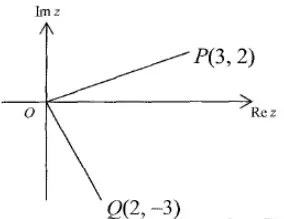 | B1, B1ft |
| (2) |
Notes
(b) Position of points not clear award B1B0
| Scheme | Marks |
|---|---|
| grad. \(OP \times\) grad. \(OQ = \dfrac{2}{3} \times -\dfrac{3}{2}\) | M1 |
| \(= -1 \quad \Rightarrow \angle POQ = \dfrac{\pi}{2}\) (*) | A1 |
| (2) |
OR
| Scheme | Marks |
|---|---|
| \(\angle POX = \tan^{-1}\tfrac{2}{3},\ \angle QOX = \tan^{-1}\tfrac{3}{2}\) | |
| \(\tan(\angle POQ) = \dfrac{\frac{2}{3} + \frac{3}{2}}{1 - \frac{2}{3} \times \frac{3}{2}}\) | M1 |
| \(\Rightarrow \angle POQ = \dfrac{\pi}{2}\) (*) | A1 |
| (2) |
Notes
(c) Use of calculator / decimals award M1A0
| Scheme | Marks |
|---|---|
| \(z = \dfrac{3 + 2}{2} + \dfrac{2 + (-3)}{2}\mathrm{i}\) | M1 |
| \(= \dfrac{5}{2} - \dfrac{1}{2}\mathrm{i}\) | A1 |
| (2) |
Notes
(d) Final answer must be in complex form for A1
| Scheme | Marks |
|---|---|
| \(r = \sqrt{\left(\dfrac{5}{2}\right)^2 + \left(-\dfrac{1}{2}\right)^2}\) | M1 |
| \(= \dfrac{\sqrt{26}}{2}\) or exact equivalent | A1 |
| (2) | |
| [10] |
Notes
(e) Radius or diameter for M1